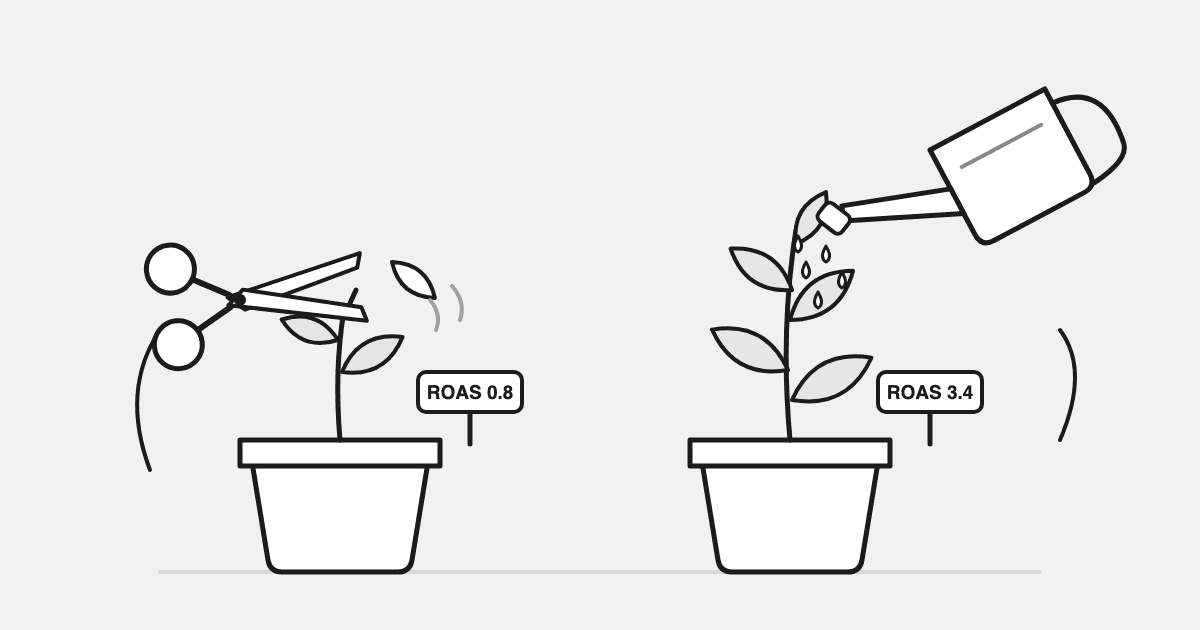
Here's the direct answer: on a fixed budget, allocate each marginal dollar to the campaign that returns the most contribution margin, not the one with the highest platform ROAS. Most operators get this backwards, and the results show. 59% of ecommerce companies spend more than 30% of revenue on ads, most of them unprofitably (Eightx, 2026). The standard frameworks (70/20/10 splits, testing reserves, weekly reviews) are fine as scaffolding. But every one of them grades campaigns on ROAS or CPA, numbers that can look great while the bank account shrinks. This guide walks through a 5-step weekly method that grades every campaign on profit instead, so your cut and feed decisions match what actually hits your P&L.
Key Takeaways
- Allocate by contribution margin per marginal dollar, not platform ROAS.
- Know your breakeven MER first. Below 2.5, incremental spend is typically unprofitable (Eightx, 2026).
- Cut campaigns below your MER floor for 2+ weeks. Feed winners 10-20% every 3-4 days.
- Protect a 10-20% testing reserve every week, no exceptions.
What Does Standard Budget Allocation Advice Get Right?
The consensus playbook is directionally sound. Meta takes 61-68% of DTC ad dollars (Common Thread Collective, Q1 2026, $231M tracked), so most fixed budgets live or die on a handful of Meta campaign decisions. The standard advice gives you real guardrails for making those decisions without wrecking delivery.
Credit where it's due. The widely cited rules, from sources like Cometly, Improvado, and Funnel, hold up in practice:
- 70/20/10: 70% of budget to proven campaigns, 20% to scaling promising ones, 10% to tests.
- A 10-20% testing reserve so next month's winners exist.
- Minimum viable budgets so campaigns actually exit the learning phase instead of starving.
- Predefined shifting triggers, like cutting 20% when CPA exceeds target two weeks straight.
- A weekly review cadence, with budget moves capped at 10-20% every 3-4 days to avoid learning resets.
The marginal-thinking test is the best of the bunch: before moving money, ask "if I put another $100 into this campaign, will it outperform another $100 anywhere else?" The highest-ROAS campaign doesn't automatically deserve more budget. If its audience is saturated, the next $100 there performs worse than the last $100 did.
Here's what every one of those frameworks has in common, though. They grade campaigns on ROAS and CPA. Not one of them asks whether the campaign makes money after product costs, shipping, fees, and discounts. That's the gap this method closes. The five steps below run as a weekly ritual, about 30 minutes once the numbers are in front of you.
Step 1: What's Your Breakeven MER?
Before touching a single budget, know your floor. Healthy MER (marketing efficiency ratio, total revenue divided by total ad spend) runs 3.0 to 5.0 for most ecommerce brands, and below 2.5 incremental spend is typically unprofitable (Eightx, 2026). Your specific floor comes from one formula: breakeven MER = 1 divided by your contribution margin percentage before ad spend.
Work it through with real numbers. Say your gross margin is 55%. Now subtract everything else that scales with an order: shipping eats 8 points, payment and platform fees take 4, discounts average another 3. You're left with a contribution margin of 40% before ad spend.
Breakeven MER = 1 / 0.40 = 2.5.
That number is the spine of every decision that follows. Any campaign returning less than $2.50 in real revenue per $1 spent loses money on incremental spend, no matter what the in-platform ROAS says. A brand with 60% contribution margin has a floor of 1.67 and can profitably run campaigns that would bankrupt a brand with 30% margin and a floor of 3.33. This is why copying another brand's "target ROAS" is meaningless. Their floor isn't yours.
For context, brands in the $1-10M GMV range typically spend 15-30% of revenue on ads (Eightx, May 2026). If you're above that band and below your breakeven MER, the fix isn't reallocation. It's less spend.
Step 2: Are You Grading Campaigns on Margin or on Platform ROAS?
Platform-reported revenue overcounts by 30-100% when you sum it across channels, because each platform claims credit for the same order (r/FacebookAds practitioner reconciliation threads, 2026). That's not deception. Each platform measures what it can see. But it means grading campaigns on in-platform ROAS grades them against inflated revenue and zero cost data.
The line practitioners use sums it up: "Blended ROAS is what the platforms claim; MER is what your bank account shows."
So grade every campaign against two things: your actual Shopify revenue, and your real costs. That second part matters just as much as the first. ROAS treats every dollar of revenue as equal. Your P&L doesn't.
Here's the trap in concrete terms. Campaign A shows a 4.0x platform ROAS. Looks like your winner. But it sells a 30%-off bundle of your lowest-margin SKU, and after the discount, product cost, and shipping, contribution margin on those orders is 22%. Its breakeven MER is 4.5. At a real (deduplicated) MER closer to 3x, Campaign A loses money on every order.
Campaign B shows a 2.5x ROAS on full-price, high-margin products with a 45% contribution margin and a breakeven of 2.2. Campaign B is quietly profitable. Every ROAS-based framework feeds A and cuts B. The margin-based grade does the opposite, and the margin-based grade is the one your bank balance agrees with. If you haven't built a blended view yet, start with our guide to calculating blended ROAS across channels, then apply your margin math on top.
Step 3: What Goes on the Cut List This Week?
Three categories earn a cut, and creative fatigue is the most common. The standard thresholds: frequency at 3.5+ and CTR down 15% or more week over week means refresh now, and one signal alone is noise but two moving together over seven days is fatigue (practitioner consensus documented across Triple Whale and Madgicx, 2026).
Your weekly cut list:
- Campaigns below your breakeven MER for 2+ consecutive weeks with no structural fix in flight. One bad week is noise. Two weeks below the floor with the same creative, same landing page, and same offer is a pattern. Cut 20% immediately, or pause outright if it's far under.
- Ads pointing at out-of-stock products. This is pure burn, and it's more common than anyone admits. Nobody assigned the job of cross-checking ad destinations against inventory, so it doesn't happen. Check it weekly.
- Creatives past fatigue thresholds. Frequency 3.5+, CTR down 15%+. The winner isn't coming back on its own; winning creatives now commonly die within 10-16 days at scale. We cover the full signal set in the creative fatigue signals guide.
One caution before you cut: make sure the campaign is actually the problem. A sudden drop can be a landing page issue, a stock-out, or an auction shift rather than the campaign itself. Here's how to tell whether a winning ad died or something broke around it.
What about campaigns hovering right at the floor? Don't cut, don't feed. Hold budget flat, change one variable (usually creative), and recheck in seven days. That's the Watch tier in the table below.
Step 4: Which Campaigns Should You Feed, and How Fast?
Feed campaigns above your target MER that still have headroom, at 10-20% every 3-4 days, never doubled overnight. Big jumps reset Meta's learning phase and tank efficiency, which is why the 10-20% cadence is the convention across nearly every practitioner guide (Cometly and Eightx, 2026). Headroom means frequency is still low, ideally under 2.5, and CPA has held stable through the last increase.
Now the honest part most guides skip: scaling has a wall. Pushing spend forces the auction to find you more expensive customers, so CPA rises as budgets grow. One founder in r/FacebookAds put it exactly:
"When we keep the budget between $150 and $300 a day, the CPA is beautiful... the second we try to push past $500/day, rising CPA wipes out the entire profit margin." (r/FacebookAds, 2026)
Sound familiar? Here's what the profit lens adds that the ROAS lens can't. Your breakeven MER tells you where your wall is. As you feed a campaign, watch its marginal MER: the efficiency of the newest dollars, not the average. A campaign can hold a healthy 3.5x average while its last budget increase only returned 2.6x. With a breakeven of 2.5, that campaign is nearly done scaling. With a breakeven of 1.8, it has room to run.
Scale in 10-20% steps until marginal MER approaches your floor, then stop feeding budget. Past that point, the constraint isn't budget mechanics, it's creative diversity. New angles and new audiences reset the wall. More money into the same ad does not. In our experience across the accounts we've run, the brands that break through spend plateaus are the ones shipping new concepts, not the ones tweaking bids.
Step 5: Why Protect the Testing Reserve?
Because winners are rare and they expire. Only 4-8% of ad creatives become winners, per the largest public creative dataset: 578,750 ads and $1.3B in spend (Motion, Creative Benchmarks 2026). At the account level, practitioners consistently report 1-3 winners per 10 tests. That hit rate is normal, not a sign you're bad at this.
Run the math on what that means for a fixed budget. If winners die in 10-16 days and one test in ten becomes a winner, you need a steady testing pipeline just to maintain performance, let alone grow it. The 10-20% testing reserve isn't optional overhead. It's the supply line for everything in your 70%.
Here's the trap on a fixed budget: testing is always the easiest line to raid. A winner wants more spend, the month's target is close, and the test budget quietly becomes scaling budget. It feels free. It isn't. Starving testing this week is exactly how you have nothing to feed next month, and why accounts hit a cliff about 4-6 weeks after they stop testing.
Treat the reserve as untouchable. Fund 2-4 new creative tests weekly from it, give each enough spend to get a real signal, and expect most to fail. The occasional winner pays for all of them.
The Cut / Watch / Feed Decision Table
Most brands need this discipline more than they think: brands at $1-10M GMV should hold ad spend to 15-30% of revenue, yet 59% of ecommerce companies exceed 30%, mostly unprofitably (Eightx, May 2026). A fixed weekly rubric is what keeps allocation decisions from drifting back to gut feel. Here's the whole method in one table.
| Verdict | Criteria (graded on real revenue and real costs) | Action this week |
|---|---|---|
| Cut | Below breakeven MER for 2+ consecutive weeks with no fix in flight; or ads pointing at out-of-stock products; or frequency 3.5+ with CTR down 15%+ | Reduce budget 20% now, or pause. Reallocate to the Feed list |
| Watch | Within roughly 10% of breakeven MER either side; or above the floor but frequency climbing past 2.5 and CTR softening | Hold budget flat. Change one variable (usually creative). Recheck in 7 days |
| Feed | Above target MER (breakeven + 0.5 or better) on Shopify-reconciled revenue; frequency under 2.5; CPA stable through the last increase | Increase budget 10-20%. Wait 3-4 days. Repeat until marginal MER nears your floor |
Run this once a week, same day, every week. The grading takes most people a spreadsheet and an hour of pulling Shopify revenue against campaign spend. That weekly grading is exactly what Datadrew ships as the Cut/Feed Call: the weekly call on what to cut and what to feed, graded on contribution margin across every ad account, built on numbers reconciled to your Shopify orders overnight, from $149/mo flat. Whether you run it in a spreadsheet or let Drew do the grading, the method is the same.
FAQ
What is the 70/20/10 rule in advertising?
It's the standard fixed-budget split: 70% to proven campaigns, 20% to scaling promising ones, 10% to new tests. It's a reasonable starting scaffold. The upgrade is defining "proven" by contribution margin against your breakeven MER (typically 2.5 at a 40% margin) rather than by platform ROAS.
How often should I reallocate ad budget between campaigns?
Review weekly, but move budgets on individual campaigns no more than 10-20% every 3-4 days. Larger or more frequent changes reset Meta's learning phase and degrade delivery, which is why this cadence is the consensus across practitioner guides (Cometly, Eightx, 2026). Emergency cuts, like out-of-stock ads, are the exception: act immediately.
Should I use CBO or ABO on a fixed budget?
For prospecting on smaller fixed budgets, ABO gives you direct control over allocation, and the data supports it: ABO campaigns hit 94% of target ROAS versus 81% for CBO on prospecting (Lebesgue, 2026). CBO works better once you have several proven ad sets and want Meta distributing spend among them.
What is a good MER for ecommerce?
Healthy MER runs 3.0 to 5.0 for most ecommerce brands, and below 2.5 incremental spend is typically unprofitable (Eightx, 2026). But your real target is personal: breakeven MER equals 1 divided by contribution margin before ad spend. A 40% margin means a 2.5 floor; set your target comfortably above it.
When should I kill a Facebook ad?
Kill it when real performance stays below your breakeven MER for two-plus weeks with no fix in flight, when it points at an out-of-stock product, or when fatigue is confirmed: frequency above 3.5 and CTR down 15%+ together. One bad day is noise. Two aligned signals over a week is a decision.
How do I scale Facebook ads without killing efficiency?
Increase budget 10-20% every 3-4 days on campaigns with low frequency and stable CPA, and track marginal MER, the return on the newest dollars. Stop feeding when marginal MER approaches your breakeven. Past that wall, efficiency comes from new creative concepts and audiences, not from bigger budgets on the same ads.
The Bottom Line
A fixed budget is a forcing function, and that's a good thing. It makes you answer the only question that matters: where does the next dollar earn the most contribution margin? Know your breakeven MER, grade every campaign on Shopify-reconciled revenue and real costs, cut what's been under the floor for two weeks, feed winners 10-20% at a time until marginal returns approach the floor, and never raid the testing reserve. With healthy MER benchmarks at 3.0 to 5.0 (Eightx, 2026), most brands find at least one campaign each week that's misgraded by ROAS in one direction or the other. Run the Cut/Watch/Feed table this week and find yours. Then make it a standing 30-minute ritual, because the table only works if you actually run it.
Related reading: Why Is My ROAS Down Today? A Daily Root-Cause Framework.