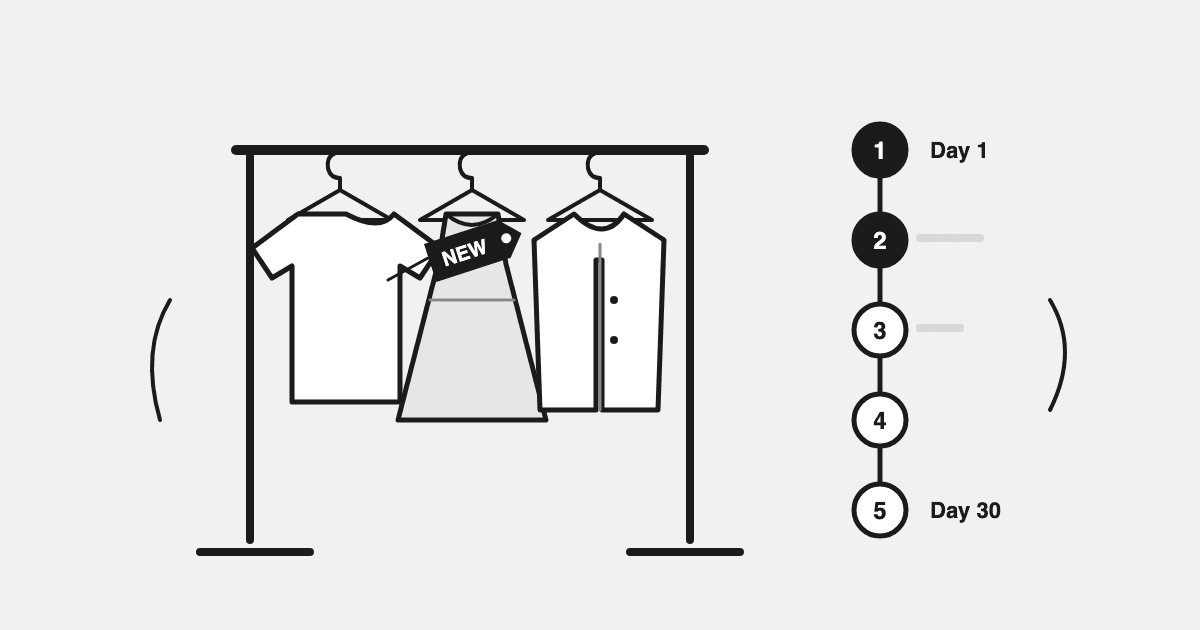
A Shopify brand launched a partnership collection in September 2026. On launch day, more than half of its sessions landed in analytics as "(not set)". Email sent almost nothing. By mid-morning the next day, Meta-reported ROAS had dropped from mid-4x to about 3x. The right call was to hold. The playbook: release the budget in five phases over 30 days, each unlocked only if the one before held your MER floor. Advertise only products that have arrived in full size runs. Give the launch its own campaign structure. Let Shopify MER, not platform ROAS, open the next phase.
The numbers come from one Shopify brand's launch, planned and monitored through Drew, DataDrew's AI ads agent. They are rounded. Your numbers will differ. The gating logic, which we call the MER-gated release, transfers.
Most launch advice says put 50 to 60% of the month's launch budget into the first seven days. That works for one hero product with deep stock. A collection is a few hundred SKUs arriving in batches, with no history. Front-load it and you spend the most when you know the least.
TL;DR
- The finding: the collection was about 15% of planned units and got roughly a quarter of performance budget, held above a MER floor around 3.5x. Launch day still had more than half its sessions untagged and no email flow.
- Release the launch budget in five phases over 30 days (15 / 20 / 25 / 20 / 20%). Each phase unlocks only if the one before it held the MER floor.
- Only advertise what has arrived, in full size runs. About a quarter of this brand's planned units sat on broken-size products.
- Run the launch in a dedicated campaign structure. Keep testing separate from scaling.
- Meta creates the demand. Google captures it. This brand's brand-search impression share was under half before launch.
- Fund the launch from your weakest legacy campaigns, not from hero-product spend.
- No winner/loser verdict in the first 72 hours unless tracking or stock is clearly broken.
Why not front-load the launch budget?
Three things break a launch-week burst.
- Learning spreads too thin. A Meta ad set needs about 50 conversions in seven days to exit learning. Spread the budget across a few hundred new products and no set gets there.
- Stock arrives in waves. Ads on a product that has not landed yet send traffic to sizes nobody can buy.
- You cannot reallocate spent money. Put 60% out before you know which families won, and 40% is all you have left to scale them.
Step 1: Size the launch pool
The launch pool is the collection's unit share plus a strategic premium, funded from your weakest campaigns. This brand's collection was about 15% of planned units and got roughly a quarter of performance budget.
- Unit share. The collection's share of the month's planned units.
- Strategic premium. A partnership or category bet creates demand the rest of the catalog can capture. That earns a premium over unit share.
The money did not come from hero-product spend. It came from a few legacy catalog campaigns running under 3x platform-reported ROAS, trimmed by about 20%. Protect the buckets that pay the bills. Fund the launch from the drag. The bucket-first allocation guide shows how to find it.
Step 2: Build a dedicated launch structure
A new collection gets its own campaign structure on day one, so partnership demand reads separately from catalog delivery. This brand split its Meta launch pool five ways.
The launch-pool structure
| Layer | Share of launch pool | Job |
|---|---|---|
| Broad prospecting with partnership-led video | 55% | Create demand from people who are not searching for you |
| Reels / Stories and engagement audiences | 15% | Cheap reach among people who engaged with the announcement |
| Product / catalog retargeting | 15% | Bring collection viewers back to the specific products they saw |
| Site visitor and add-to-cart retargeting | 10% | Close the warmest traffic |
| Creative and hook testing | 5% | Find the angles that work before scaling them |
Do not drop the collection into existing catalog or Advantage+ campaigns. Blended, you cannot tell which is working.
Separate testing from scaling
The testing layer is its own campaign. Winners graduate into prospecting. A losing hook never drags down a scaling ad set's learning.
Use product sets by style family, not by product
Build one product set per style family. Not one for the whole collection, not one per product. A single product cannot reach 50 conversions in seven days on a launch budget. A family can.
Step 3: The size-run gate
A product enters a scaling set only when it has physically arrived with its core sizes in stock. About a quarter of this brand's planned units sat on products already broken on size. This gate decided more of the launch than any creative choice.
The rule
"Listed on the site" is not enough. A product missing nearly half its sizes converts like a sold-out product. Treat blank or unverified stock as broken. Check at variant level, because product-level counts hide a bestseller with most of its sizes at zero.
The daily check
- Run a daily size-run check on every product in a scaling set. This brand automated it as an early-morning snapshot of every active variant.
- Remove any product whose core sizes drop out, the same day.
- Reinstate only when core sizes are back.
- Treat the check as a daily launch control, same as checking ROAS.
Otherwise you get ads that keep spending on products you don't have.
Step 4: Release the budget in five gated phases
The MER-gated release puts 15% of the launch pool into days one to three and holds the biggest release, 25%, for week two, after the creative and family read. Each phase unlocks only when the one before held the MER floor. Here, around 3.5x.
Phase-by-phase release schedule
| Phase | Days | Release | Objective | Gate to unlock this phase | Decision rule inside the phase |
|---|---|---|---|---|---|
| 1 | 1–3 | 15% | Launch burst, creative read | Tracking and availability confirmed clean | No winner/loser call; fix tracking or stock only |
| 2 | 4–7 | 20% | Identify winning assets and style families | At least one product set above the MER floor | Shift within the pool toward families above floor |
| 3 | 8–14 | 25% | Scale validated audiences and families | Blended launch MER ≥ floor over the prior 7 days | Above floor: +10–15% every 3 days. Slightly under floor: hold. Well under: stop scaling |
| 4 | 15–21 | 20% | Broaden prospecting | MER still holding at phase-3 spend | Same rules; new audiences only on families above floor |
| 5 | 22–30 | 20% | Concentrate on product winners | Phase 4 held | Reallocate from losers to winners; no new money |
Decision rules, graded on Shopify MER
- At or above the floor: add 10 to 15% every three days.
- Slightly under the floor (within about 15%): hold. Fix creative or the product page.
- Well under the floor: stop scaling. Move budget to the families that are working.
- No winner/loser call in the first 72 hours unless stock or tracking is clearly broken. Meta's iOS conversions lag 24 to 72 hours.
Why Shopify MER and not Meta ROAS
In the month before launch, Meta and Google together claimed about 15% more revenue than Shopify booked. During a launch, both platforms retarget the same visitors and the gap widens. MER is an efficiency ratio, not attribution. Platform ROAS ranks your ads. It cannot tell you whether the launch is profitable.
Growing the pool after phase 3
If the launch holds above the floor through phase 3, grow the pool. This brand planned to take the collection from about a quarter of performance spend toward 30% in the second half of the month, funded from legacy catalog trims. Never from hero spend.
Step 5: Let Google capture what Meta creates
A partnership launch creates search demand. Fund Google to catch it. Before this launch, this brand's brand-search impression share was under half, and Performance Max was losing more than half its impression share to budget. Partner posts send people to search the collection name. At that share, many find a competitor or reseller first.
The launch Google plan
| Lever | Change | Rule |
|---|---|---|
| Brand search | Daily budget up 20 to 30% before launch | Move higher only if impression share stays below about 70% |
| Performance Max | Step up in three increments over two weeks | Add the collection's assets and a dedicated product group |
| Demand Gen / YouTube | Double for launch | Partnership video; scale only after conversion validation |
Raise each lever no more than every three days. Cap Google at about 10% of performance spend unless MER holds. Google's reported ROAS on brand search runs in the tens and is not comparable to Meta's. It captures demand Meta created. Grade it on incremental brand-search volume.
The three pre-launch checks nobody runs
Three non-ad checks decided how much of this launch could be measured. All three were gaps.
The launch email and SMS flow exists and is scheduled
On launch day, email sent almost no traffic. Nobody had built a launch flow. The highest-ROAS channel sat out the biggest day of the month.
UTMs are on every link
Every post, story, creator brief and email needs tagged links. Partner posts without UTMs land in "(not set)" and you never learn what they did.
The pixel and Conversions API reconcile against Shopify
Check Events Manager against Shopify orders for the previous week. A launch is the worst time to find a tracking gap.
What launch day actually looked like
More than half of launch-day sessions landed as "(not set)". The morning after, a drop of about a third by mid-morning was a broad partial-day dip. The call was hold.
Launch day: what the source data showed
Which channel drove the uptick? Honest answer: mostly paid social, probably. The launch video ran at roughly 10x Meta-reported ROAS. But partner posts, creator stories and shares carry no tagging, and the analytics channel grouping classifies paid-social traffic badly. "Clearly" is not "measured". Two fixes: a launch flow in email, and a pixel and Conversions API audit before the next drop.
The morning after: the hold decision
By mid-morning on day two, revenue and ROAS were down about a third against the same hour the day before. One launch video had spent with zero purchases. The brand waited. Four reasons:
- Spend was flat. Not a budget or learning-phase problem.
- Shopify showed the same drop as Meta. Not a tracking break.
- The drop was spread across nearly every ad and both platforms. Not one creative.
- It was less than half a day in. 24 to 72 hours of iOS conversions still had to land.
The zero-purchase video did not meet the kill rule either: zero conversions after two to three times your target CPA in spend, or CPA at 1.5 to 2x target for several days after learning. It had spent a fraction of one target CPA. Flag it, don't pause it. The five-layer daily check said hold. The 72-hour rule said hold.
Weekly operating cadence during a launch
Daily gates, weekly moves.
- Daily: size-run check on every product in a scaling set. Same-hour comparison against yesterday. Diagnose, don't act, on partial-day data.
- Every three days: compare each style family's spend share, units sold and Shopify MER against the phase target. Release the next increment only if the gate is met.
- Weekly: move no more than 10 to 15% of the launch pool between families or layers. Kill nothing on one week of data unless it is a creative showing fatigue signals or a product that has gone broken.
- End of phase 3 (day 14): the go / no-go on growing the pool. Blended launch MER over the trailing seven days, on Shopify revenue, against the floor.
What this costs you if you do it by hand
Every gate is a query: inventory by variant, spend by product set, Shopify revenue by SKU, sessions by source. Most brands run a launch with three people refreshing four dashboards. The gates get checked on day one and day two, then quietly stop.
Running this without a war room
This brand ran the launch through Drew, DataDrew's AI ads agent. Upload the unit plan, ask how to allocate, ask for channel levers, ask for an operating document. Out came the launch pool, the phase schedule, the Google headroom and the legacy campaigns to trim. The size-run snapshot runs as a scheduled automation. Launch day's source analysis and the morning-after root cause were one question each, and each came back with a verdict and its reasons. A phased launch stays phased when the gates cost nothing to check.
FAQ
How much budget should I put behind a new collection launch?
Start from its share of the month's planned units, then add a premium for a strategic or partnership launch. This brand's collection was about 15% of units and got roughly a quarter of performance budget, funded from legacy catalog campaigns under 3x.
Should I put most of the launch budget in the first week?
Not for a collection. Release it in five phases, 15 / 20 / 25 / 20 / 20% over 30 days, each unlocked only if the one before held your MER floor. The biggest release goes in week two, after you know which style families won.
How do I scale Facebook ads without killing efficiency?
Scale in 10 to 15% steps every three days, only on ad sets above your MER floor. Keep testing in a separate campaign. This brand held a floor around 3.5x while taking its collection to roughly a quarter of spend in 30 days.
When should I judge whether a launch is working?
Not in the first 72 hours, unless tracking or stock is visibly broken. Grade on Shopify MER over rolling seven-day windows. Make the go / no-go on growing the pool at day 14.
Should new products go into my existing catalog campaigns?
Not at launch. Run a dedicated structure with product sets by style family, so each set can reach the roughly 50 conversions in seven days Meta needs to exit learning. Merge into evergreen catalog campaigns once the winners are clear.
Do I need Google Ads for a Meta-led launch?
Yes, for capture. This brand's brand-search impression share was under half before launch. Raise brand search and Performance Max before launch day. Grade Google on incremental brand-search volume, not its reported ROAS.
What should I check before launch day besides the ads?
That the launch email and SMS flow is built and scheduled. That every link in every post and creator brief carries UTMs. That the pixel and Conversions API reconcile against Shopify orders. All three were gaps in the launch above.