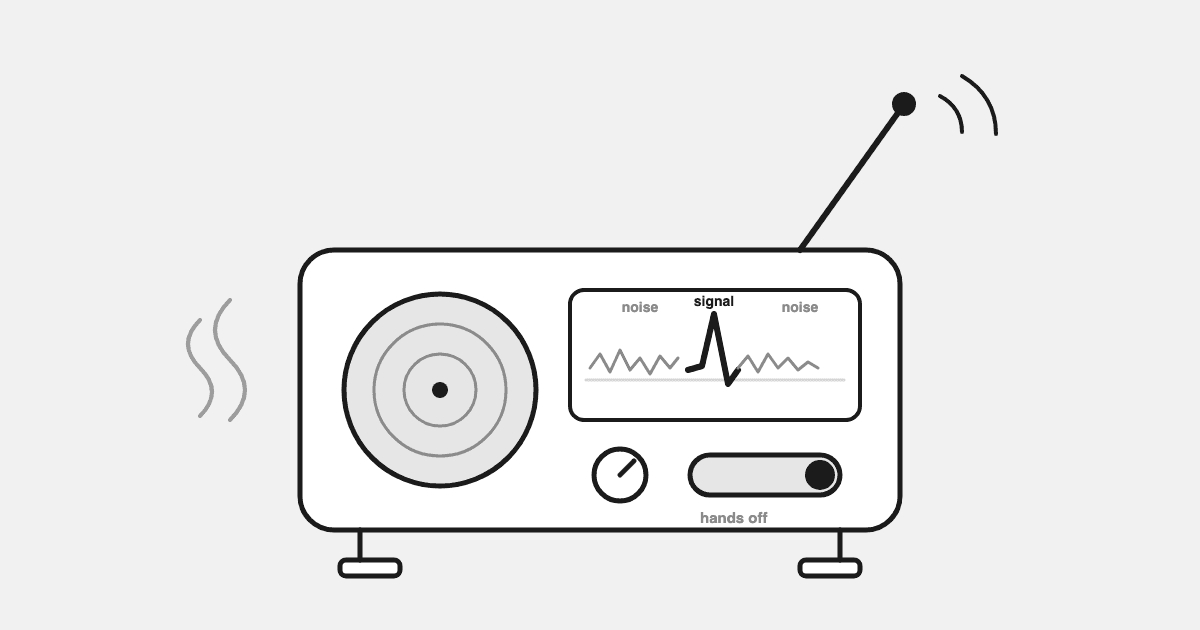
The difference between a signal and noise in your ad account is whether you had a threshold written down before you opened the dashboard. If you did, yesterday's number either crossed it or it did not. If you did not, every number is a signal, and every signal is an edit.
"checked ads manager before brushing my teeth. and at the school play. and at 2am. dread, not learning." That line is a composite from our operator research, stitched from three founder conversations. The check is compulsive because the stakes feel binary: something is wrong and every hour costs money, or nothing is wrong and every edit costs learning. Both fears are correct. Panic-checking cannot tell you which one you are in.
This post covers the decision before you touch the account. It is one of three: the 15-minute daily root-cause framework is the diagnosis after a drop, and why your ROAS dropped is the causes in the order to check them. Here you get the numbers that separate signal from noise, the six intervention states a media buyer works in, and what an "act now" has to earn.
TL;DR
- Write the threshold before you look. The industry's numbers: zero conversions after 2–3× target CPA, CPA 1.5–2× target for a week, frequency above 4.5, budget steps of 15–30% every 48–72 hours, 50 conversions in 7 days to exit learning.
- Those are starting points. The six intervention states are what you do with them; "hold and observe" and "do not act" are decisions with a reason, a window and a trigger.
- Over-intervention is the expensive failure: a material edit on Meta can restart learning, and stacked edits cannot be read.
- An "act now" is earned: alternatives ruled out, materiality checked, rollback rule written first.
- One read a day on yesterday's complete numbers. Conversions keep reporting for 24–72 hours.
The Numbers That Separate Signal From Noise
A signal is a move that crosses a threshold you set in advance, on enough conversions to mean something, after the platform has finished reporting. Everything else is noise until proven otherwise. Here are the thresholds that media buyers, Meta's own documentation and the tools built on top of it converge on. Treat the third column as the point: every one of these is a starting point for a $500K–$30M Shopify account, not a rule.
| Question | Threshold most operators use | Starting point, not a rule |
|---|---|---|
| Is the ad still learning? | Meta's learning phase wants about 50 optimisation events in 7 days per ad set; under that, delivery is unstable | A $300 product may never hit 50. Judge by conversions collected, not days elapsed |
| Has an ad with no sales had a fair test? | Zero conversions after spending 2–3× your target CPA is the common kill line | AdManage's kill table puts it at 2.3× (90% confidence) to 3.0× (95%); at one conversion it stretches to 3.9–4.7×, at two to 5.3–6.3×, at three to 6.7–7.8× |
| Is a high CPA a real problem? | CPA at 1.5–2× target for about 7 consecutive days, after learning, is a reduce-or-kill signal | On a $30-a-day ad set it is not an emergency. Materiality first |
| Is the creative tired? | Frequency above 4.5 with CTR falling and CPA rising; on prospecting most buyers act at 2.5–3.0 | Retargeting tolerates less, broad more. Read frequency with CTR, never alone |
| How fast can I scale? | Raise budgets 15–30% per step and wait 48–72 hours before the next | Bigger steps on Meta restart learning; Google's Smart Bidding has the same rhythm with a longer fuse |
| Can I trust yesterday's number? | Conversion reporting lags 24–72 hours through the pixel, CAPI and attribution windows | Yesterday's ROAS is understated at 9am and finishes reporting the day after tomorrow |
The numbers are useful because they are boring: they stop the 2am version of you inventing a threshold that fits the mood. They are also all platform-side. No CPA multiple tells you that a hero SKU sold out on Friday, which is what the next section is for.
Signal or Noise? The Three Questions Before Any Edit
Ads Manager shows a number and a colour, never the reason. So the operator supplies one, usually the scariest, and acts on it by lunch. Stop at the number and ask three things, in order.
- Is this a real signal? A move that crossed a threshold from the table, survived a full conversion cycle on enough conversions, with the business underneath unchanged.
- Is this normal variance? A daily swing inside the range this account produces every week when nothing has happened. Most "drops" are this.
- Is this my own recent change? A budget step, new creative, an audience edit, a landing-page or price change. Recent edits make short-window comparisons untrustworthy, and the learning phase you just restarted is the commonest culprit.
Nobody upstream makes this call for you. In April 2023 Meta's delivery system malfunctioned, accounts spent roughly 90% of their daily budgets by 9am and CPAs roughly tripled (CNBC); a CMO spending $75–100 million a year could not raise a human at Meta afterwards (AdExchanger). At $2 million, the intervene-or-wait call is yours, every morning.
Here is the practical test for each question.
| Check | Reads as noise when… | Reads as signal when… |
|---|---|---|
| Window | The move is one or two days old; yesterday's ROAS is always lower than it will be once conversions finish reporting | It persists across a full 7-day cycle against the same days of the previous cycle |
| Volume | The "drop" sits on a handful of conversions; on 20 orders, one big basket moves ROAS 15% on its own | The window holds enough orders that the swing sits outside the usual week-to-week range |
| Your own edits | You changed budget, creative, audience, bid or the landing page in the last 3–7 days | The account has been untouched long enough that learning has settled and the comparison is clean |
| Calendar | It is Tuesday after a strong Sunday, the day after payday, or your own email send moved the mix | Same weekday, same position in the month, and the move is still there |
| Business reality | Something outside the ad account moved: a hero SKU sold out, a discount code broke, a price changed, a promotion ended | Stock, site conversion, pricing and promotions are steady, so the ads are the remaining suspect |
| Measurement | Shopify orders are flat while platform-reported conversions fell: the pixel, CAPI or an attribution setting changed | Shopify orders and platform conversions fell together |
Four of the six checks live outside the ad account. A Shopify merchant watched conversion rate fall from about 1.8% to 0.3% for weeks; the cause was a discount code that had stopped applying in the cart drawer (Shopify Community, a verified post in our research). No edit in Ads Manager would have fixed that, and every edit would have destroyed the evidence.
Why Over-Intervention Is the Expensive Failure Mode
Freezing costs you money at the rate of one leak. Over-editing costs you the ability to see anything at all.
Three reasons. The first is mechanical: Meta treats most material edits (budget steps beyond roughly 20%, new creative, audience or bid changes) as a reason to re-enter learning, which needs about 50 optimisation events to settle. Edit Monday, panic Wednesday, edit again Thursday, and the campaign spent the week learning instead of selling. Google's Smart Bidding has the same rhythm with a longer fuse.
The second is evidential. Change two things at once and you cannot attribute the result to either. Operators who "just try a few things" on a bad Tuesday end up on Friday with a different account and no idea which change helped. One causal edit at a time, unless you are containing an emergency, and even then write down what you changed.
The third is reversibility. A budget cut is easy to undo; deleting an ad set is not, the history goes with it. When confidence is incomplete, prefer the reversible action, and prefer no action to an irreversible one.
The honest tally: a real problem left for three days costs three days of one leak. A reflex edit on noise costs a learning reset, a muddied comparison and, often, the winner you just killed for having a bad Tuesday. Plenty of accounts are not underperforming. They are over-managed.
The Six Intervention States
Experienced buyers do not work in "act" or "wait". They work in six states, chosen from the evidence, not the mood. The thresholds above are the entry conditions; the state is what you do once one is met.
| State | Entry condition (with the number) | What you do | What you don't do |
|---|---|---|---|
| Act now | Evidence and urgency both high: a tracking break, spend to a sold-out product, a broken checkout, or zero conversions after 2–3× target CPA | The one change that addresses the cause, rollback rule written first | Fix a measurement failure with a media-buying edit |
| Act cautiously | The evidence points one way but volume is thin or the window is short: CPA at 1.5–2× target for 7 days, or frequency above 4.5 with CTR falling | A small, reversible step (a 20–30% budget cut, a creative swap), then observe a full cycle | Make the full-size move you would make on strong evidence |
| Run a controlled experiment | The uncertainty itself is worth money: does brand exclusion help, does the new offer convert | Isolate the variable in its own campaign or period, fixed budget, fixed window (7 days, 50+ conversions) | Force equal spend to make the test look tidy; that has an opportunity cost |
| Investigate first | The move is real (it crossed a threshold on a full cycle) but the cause is not established | Work the diagnostic order: measurement, business reality, account state, then the funnel | Touch the account before you know which layer moved |
| Hold and observe | A recent change (3–7 days), under 50 conversions in the window, or the 24–72 hour reporting lag makes action premature | Name the window and the trigger, then wait it out | Re-check hourly. The number has not finished reporting |
| Do not act | The move sits inside the account's usual weekly range, or the proposed change adds risk without expected value | Record why waiting is the better decision, and close the tab | Make a change to feel like you did something |
Most operators only ever use the first row. Their account needs the last three far more often.
"No Action" Is a First-Class Decision
There is a difference between a deliberate hold and neglect, and it is written down.
A deliberate hold has a reason ("budget stepped up 25% on Monday, learning settles by Thursday"), a window ("re-read Friday on the full 7 days"), and a trigger ("if CPA is still 30% above the prior cycle on Friday and Shopify orders confirm it, cut back to Monday's budget"). Neglect has none of those. Same non-action; one is management, the other avoidance. If you cannot say what would make you act, you have not decided to wait; you have decided not to look.
This is also the answer to the 2am check, which is trying to resolve uncertainty a partial day's data cannot. Write the window and the trigger down at 9am, and the 2am version of you has nothing to do.
How to Earn an "Act Now"
An "act now" is expensive if it is wrong, so it has to be earned. Before the change goes in, a real recommendation contains the following, whether it comes from a media buyer, from you, or from an AI agent.
- The observation: what moved, at what level (account, campaign, ad, product), over which windows.
- Materiality: how much money this is about. A 40% CPA rise on a $30-a-day ad set is $12 a day, not an emergency.
- The diagnosis and the alternatives: the likely cause and the two or three others that produce the same numbers. No alternative named, no diagnosis made.
- Evidence and confidence: which numbers and business facts support it, and an honest low, medium or high.
- Platform state and context: learning, recently edited, in a promotion? What do margin, stock and new-customer value say about the cost of being wrong?
- The action with magnitude and timing: not "reduce budget" but "$800 to $600 tomorrow morning, before the daily reset".
- Guardrails: the limits the change stays inside, and the entities it must not touch.
- The window and the rollback rule: when you will judge it, and what would reverse it.
Do this once by hand and you will notice that half the "act now" impulses fail at alternatives, and most of the rest fail at materiality. That is the discipline working.
Where Each State Sends You
The states are a router. Each one has a next page.
- Investigate first sends you to the diagnostic order in why your ROAS dropped; the fifteen-minute daily version is the daily root-cause framework.
- Act now or act cautiously on a scaling move sends you to marginal ROAS, what the last budget step actually earned, and then to the cut-or-feed method to size the move.
- A suspected creative problem sends you to the fatigue read first, because a winner that "stopped working" has five impostors and only one is fatigue.
Making It a Daily Discipline Without Living in Ads Manager
The tab is open all day, and the day's numbers are wrong all day, because conversions have not finished landing. Here is the cadence that replaces it.
One read a day, at the same time, on yesterday's complete numbers, with Shopify orders next to the platform figures. Ask the three questions. Assign a state. If it is anything other than "act now", write the window and the trigger and close the tab. Weekly, a longer read for allocation: marginal efficiency, creative rotation, what to feed and cut. Monthly, the slow numbers: new-customer share, product mix, payback.
Daily is the right cadence for the call itself. Intraday numbers are incomplete by construction; a weekly read misses a leak for six days. Yesterday, read once, on complete data, is where the signal lives.
How Drew fits
- Ask Drew "what changed yesterday, and is it real?" Its diagnosis separates real signal from normal variance, working through the same order as above (measurement, the Shopify business behind the ads, account state, then the funnel), and it includes the case where the honest answer is to leave the account alone.
- Drew's checks run daily: it reads yesterday, not the last hour, and a daily read is the right cadence for telling signal from noise.
- The six states above are published method, the vocabulary a good buyer works in. Drew gives you the diagnosis and the reasoning; the call on whether to touch the account stays yours.
- Pricing is published and flat, and the free plan doesn't need a card.
Key Takeaway
Every anomaly is a real signal, normal variance, or the echo of your own change. Decide the threshold before you look, starting from the industry's numbers: zero conversions after 2–3× target CPA, CPA at 1.5–2× target for a week, frequency above 4.5, 15–30% budget steps every 48–72 hours, 50 conversions to exit learning. Work in six states, not two; treat "hold" and "do not act" as written decisions with a window and a trigger; make an "act now" earn its place. Read once a day on yesterday's complete numbers, and close the tab.
FAQ
Should I change my Facebook ads now or wait?
Wait if the move is under a full 7-day cycle old, sits on fewer than 50 conversions, follows an edit in the last 3–7 days, or the business underneath the ads changed (stock, site conversion, pricing, a promotion). Act now only when evidence and urgency are both high: a tracking break, spend to a sold-out product, a broken checkout, or zero conversions after 2–3× target CPA. Write the rollback rule first.
When should I kill a Facebook ad and when should I scale it?
Kill when it has spent 2–3× your target CPA with zero conversions, or when CPA has sat at 1.5–2× target for about 7 days after learning, and the cause is the ad rather than the store or the tracking. Scale when CPA has held at or under target for a full 7-day cycle on 50 or more conversions, in steps of 15–30% with 48–72 hours between them. Anything in between is a hold, an experiment, or a cautious step, not a big move.
How long should I run Facebook ads before deciding?
One full conversion cycle after the last material edit, which for most Shopify brands means 7 days, and long enough to collect about 50 conversions. Two days of data is incomplete reporting on unsettled learning. If volume is low, extend the window rather than lowering the bar.
When should I kill a Facebook ad?
When it has had a fair run (a full cycle, 2–3× target CPA in spend), its efficiency sits below break-even on Shopify revenue rather than only on platform numbers, and the cause is the ad itself rather than a site, stock or measurement problem that would sink any ad. Pause rather than delete, so the history and the option to restart both survive.
How often should I make changes to my ad account?
Less often than you want to, one causal change at a time. A daily read is right; a daily edit usually is not. One deliberate change per campaign per 7-day cycle, budget steps of 15–30% at most, creative refreshes on their own schedule. If you cannot say which of last week's edits caused this week's result, you made too many.
Is a one-day ROAS drop a real signal?
Almost never on its own. Yesterday's ROAS is understated because conversions keep reporting for 24–72 hours, one basket moves a low-volume day by 15% or more, and day-of-week effects are bigger than most operators assume. Check business reality (stock, site, pricing) and measurement, then hold and re-read on the full 7 days.
What counts as normal variance in Meta ads?
The range your account produces week to week when nothing has changed. Take the last eight clean weeks and note the spread of weekly ROAS and CPA. Daily swings of 20–30% around the weekly figure are common at modest volumes. A move inside that spread is noise by definition, whatever it feels like at 2am.
Written by Sumit Bansal, co-founder of Datadrew. Published 3 September 2026, revised 7 September 2026. Quotes and figures are linked to their sources inline; the opening line is a composite from our operator research and is labelled as such. Thresholds are industry starting points, not Datadrew benchmarks.