“Assume that you will have a 10% hit rate on all the new ads you test.” Ash Melwani, CMO of Obvi, said that in a piece on stay.ai's blog, then added the line any creative testing plan should start from: “If you're testing 10 ads a week, you can expect MAYBE 1 to hit.”
Run that at your size. If you're a Shopify founder or growth lead at $5M–$50M a year spending $200K a month on Meta, your team probably ships around 30 new ads a month. At 10%, three of them carry next month's spend. Your testing framework decides whether the other 27 taught you anything.
Usually they didn't. One ad changed the concept, the creator and the hook at once, so its loss couldn't say which part failed. Ten near-copies of one idea got logged as ten tests. Somebody called a winner at four purchases. This guide fixes all three: four levels of testing, rules for moving between them, budgets worked out from your own CPA, and the weekly volume that keeps new winners coming. It's one chapter of our creative performance hub.
Key Takeaways
- → Change one level per test, and read a loss only at that level: a failed hook doesn't sink its concept. Test concepts first; hooks, iterations and new personas go on a concept that has won.
- → Graduate a concept at 15 purchases at or under target CPA, then test three structurally different hooks on it. If all three miss, stop hook-testing: the concept is the ceiling.
- → Size tests from your own CPA: 15–20× target CPA per concept, about 5,000 impressions (roughly $70 at a $14 CPM) per hook read. A month of tests for a sample account spending $186,400 costs about $15,000, 8% of Meta spend.
- → Plan volume backwards from winners: three live winners that last four weeks need about 32–33 new tests a month at a 10% hit rate, 7–8 a week.
Why most Meta creative testing teaches you nothing
Testing goes wrong in three ways, and all three look like hard work from the outside.
Near-copies get counted as tests. Ten recolors of one idea are one test with ten budgets. Connor Rolain, Head of Growth at HexClad, put the shift plainly on Motion's blog: “We used to make seventy-five ads a campaign. Now we make six that are genuinely different.”
Meta points the same way. Andromeda, the retrieval system announced by Meta in December 2024, picks a few thousand candidates from tens of millions of ads, and Meta's Advantage+ sales guidance asks for “a wide variety of diverse creative assets”. Meta's creative similarity insight goes further: ads that “appear too visually identical” can “lead to creative fatigue and increase your cost per result.”
One ad changes three things at once. A new concept, shot by a new creator, opening on a new hook. When it loses, nobody can say which of the three lost it. So a good concept can die for a bad hook, and a dead one can get fresh hooks for months.
Verdicts arrive before the evidence. A call at four purchases is a coin toss with a spreadsheet attached.
Our sample account (illustrative numbers) is Heathvane Goods, a Shopify brand selling daypacks and slings at about $18M a year, with $186,400 of Meta spend in the last 30 days, a $48 target CPA and a $118 AOV. Sixteen of its 48 live creatives are still short of 15 purchases or 5 delivery days, so a third of them can't be judged yet. Why most of your ads can't be judged yet sets out the data floors.
Now count the same account by idea.
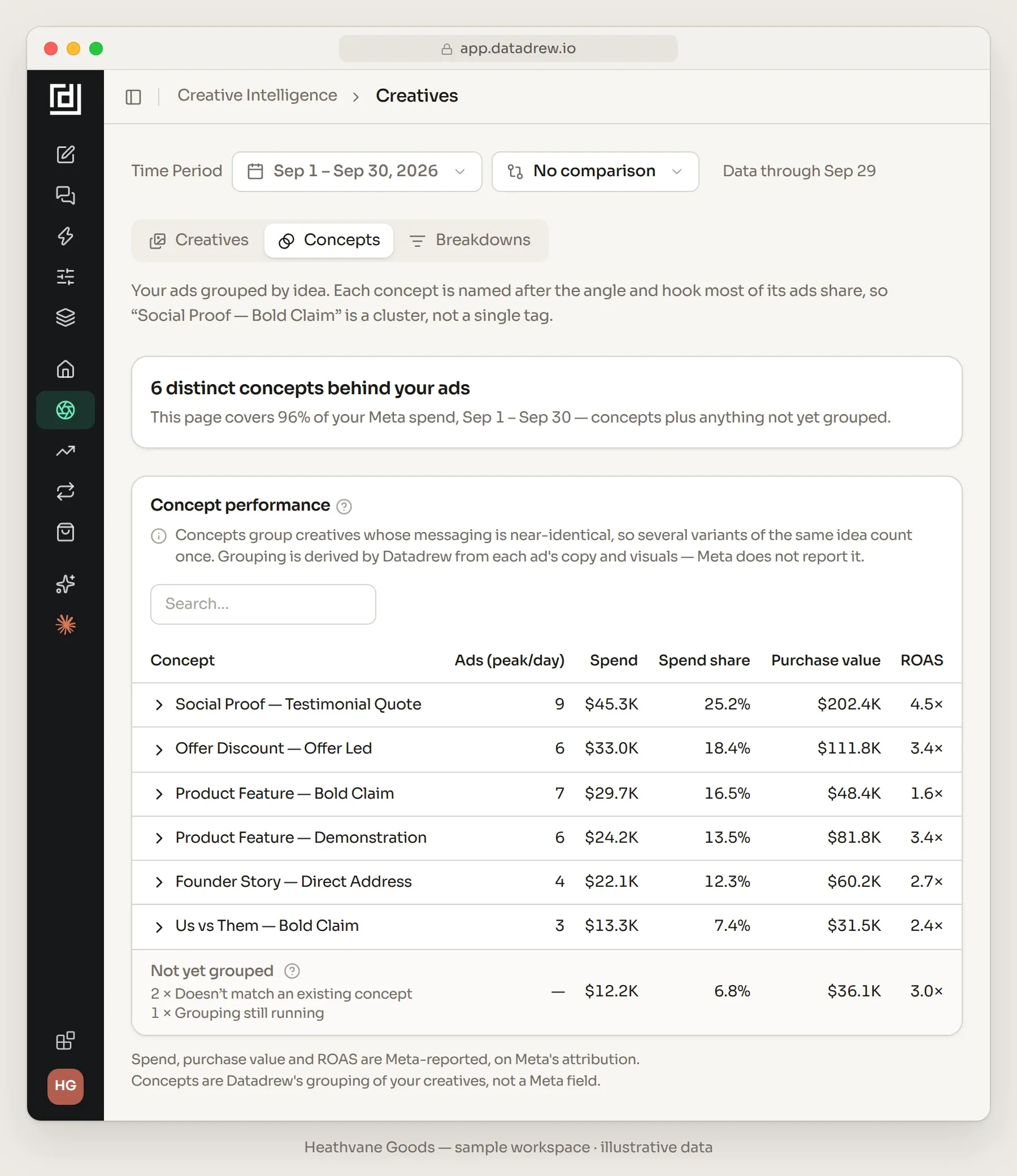
Forty-eight live creatives. Six arguments.
The four levels of creative testing, and what each one is allowed to conclude
A test only teaches you about the level it changed, so name the level before anyone briefs the ad.
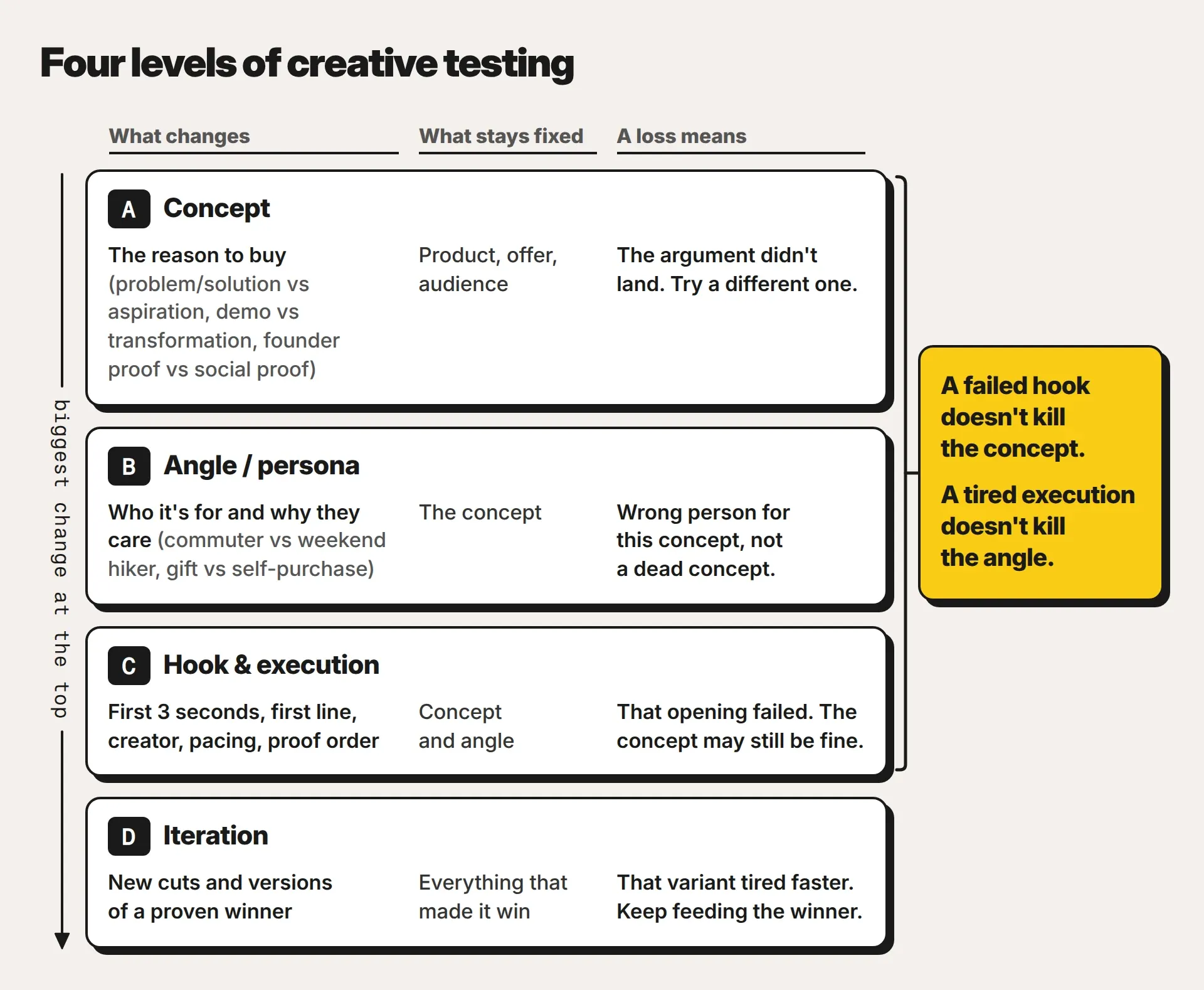
Level A, the concept, is the reason to buy: “your laptop bag is wrecking your shoulders” (problem/solution) or “one bag from desk to trail” (aspiration). If one loses with product, offer and audience held fixed, the argument didn't land: test a different one next, and don't spend hook tests trying to rescue it.
Level B is the angle or persona: the same aspiration concept pointed at weekend hikers, then at parents who carry everything. A loss means wrong person for this concept, which can still sell to the people it already works for. B usually runs last, once a proven concept has worn out its first audience.
At Level C, the hook and execution, you change how the ad opens and moves: the first 3 seconds, the first line of primary text, the creator, the pacing, the order the proof arrives in.
Level D is iteration: new cuts of a proven winner, such as a shorter edit, a new first frame or the same creator somewhere new.
The reading rule: each level can only convict itself. A flopped hook convicts the hook. A tired winner convicts that execution, and says nothing certain about its angle until the angle's other executions tire too.
Most teams read results one level too high. A hook loses, and the concept takes the blame.
| Level | What you change | What stays fixed | The question it answers | Read it on | A loss means |
|---|---|---|---|---|---|
| A · Concept | The reason to buy: problem/solution vs aspiration, demo vs social proof | Product, offer, audience | Does this argument sell this product? | Spend acceptance, then CPA vs target at 15 purchases and 5 delivery days | The argument didn't land. Try a different one. |
| B · Angle or persona | Who it's for and why they care: weekend hikers vs parents who carry everything | The concept | Does a proven concept travel to new people? | CPA and CTR in the new audience vs the concept's own baseline | Wrong person for this concept. The concept can still be fine. |
| C · Hook and execution | First 3 seconds, first line, creator, pacing, proof order | Concept and angle | Which opening earns attention for this concept? | Hook rate and hold rate vs your account median, then link CTR, then CPA | That opening failed. The concept may still be fine. |
| D · Iteration | New cuts and versions of a proven winner | Everything that made it win | How much longer can this winner run? | CPA vs its parent at similar frequency | That variant tired faster. Keep feeding the winner. |
Test concepts before hooks: the switching rules
The guides that rank for this question split roughly down the middle between concept-first and hook-first, and almost none of them says when to switch.
For a Shopify brand spending $60K–$800K a month on Meta, go concept-first. A good hook buys attention for an argument. It can't supply one, and the argument is what gets someone to pay $118 for a daypack. Some hook-first advice comes from app-install and lead-gen shops, where the conversion is a download or a form fill. Different job.
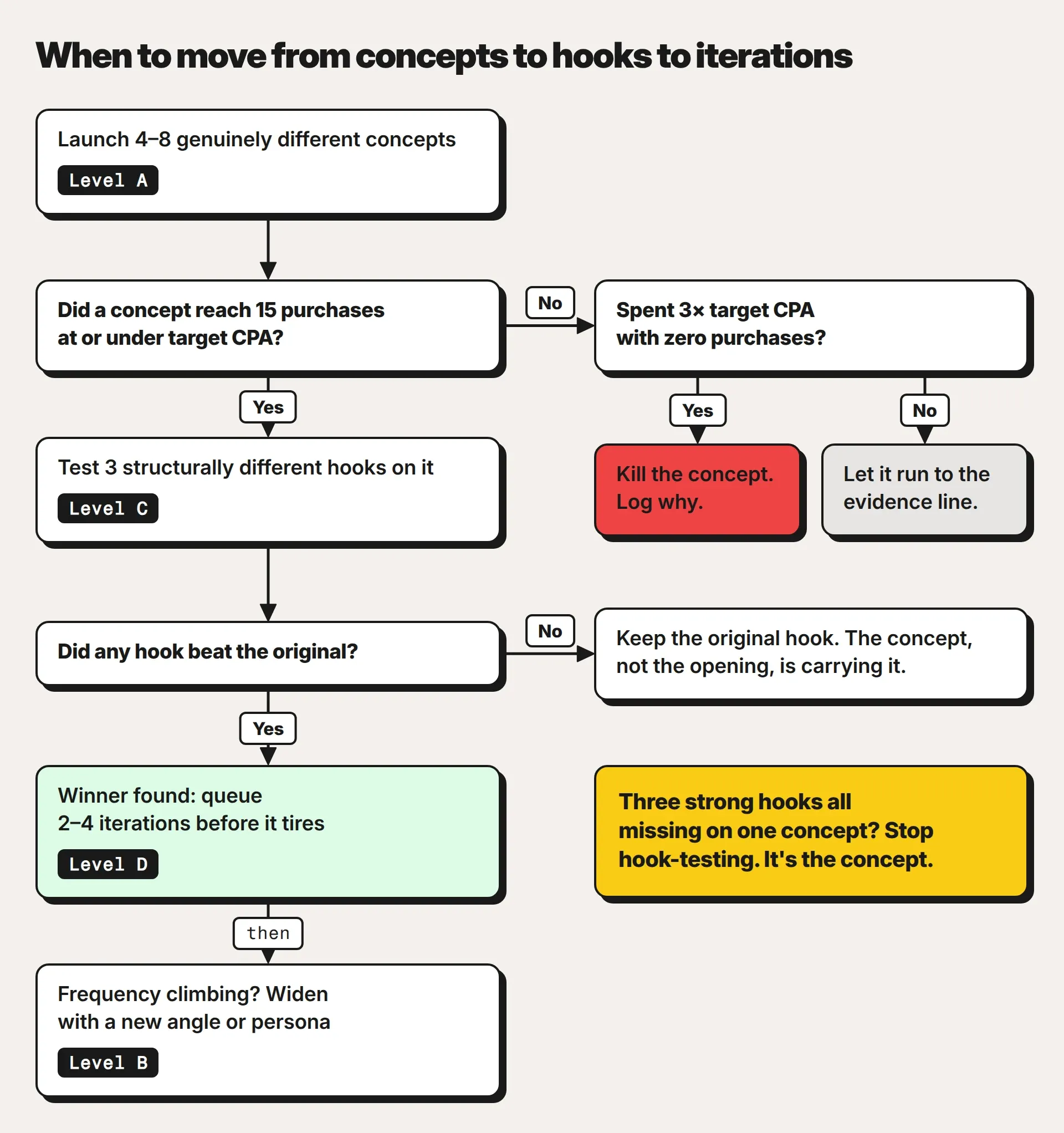
The rules, in the order you'll use them:
- → Launch 4–8 genuinely different concepts. Different means a different reason to buy. A new colorway of the same ad is an iteration at best.
- → A concept graduates at 15 purchases at or under target CPA, with at least 5 delivery days behind it. It's the same evidence line Datadrew waits for before it grades a creative, and the arithmetic backs it: at 15 purchases one order either way moves CPA by 6–7%; at four purchases, by 20–33%.
- → Then test 3 structurally different hooks on the graduate: open on the problem, on the proof, on the product in use. A new font color on the same first frame doesn't count.
- → Promote a hook that beats the original on hook rate and holds CPA. Hook rate alone won't do it: an opening that stops more people and sells worse is a better thumbnail and a worse ad.
- → If all three hooks miss target CPA with enough delivery, stop hook-testing. The concept is the ceiling. Brief a new one.
- → Kill a concept with zero purchases after about 3× target CPA, which is $144 at a $48 target. Motion's creative testing guide recommends rules that switch off an overspending test ad set after 2 to 3× target CPA. With zero sales, the top of that range is patience enough.
- → Once a winner exists, queue 2–4 iterations before it tires. When it does tire, work out which level is tiring before you brief the replacement.
- → When the winner's frequency climbs past about 2.5 while link CTR slides, widen with a new angle or persona (Level B): the same concept, pointed at people who haven't seen it yet.
How much to spend on a creative test, worked out from your own CPA
Published minimums differ by about 100×. At a $40 CPA, the ranking guides run from roughly $40 per variant (48 hours at $20 a day) to roughly $4,000 (100 conversions per variant), and neither end shows the math. Derive your own in two minutes.
Concepts need purchases
A concept read is a CPA question, so it runs on purchases. Fifteen purchases at target cost 15× target CPA, and a concept in test usually runs above target, so add a buffer: 15–20× target CPA per concept. At a $48 target that's $720–$960.
Hooks need impressions first
A hook read asks whether the opening stops people: hook rate, 3-second video views ÷ impressions (Meta's Help Center now defines it the same way). Purchases come later, for the hooks that earn them.
Mind the sample size. At a hook rate around 28%, 5,000 impressions pin the reading to within about ±1.2 points (a 95% interval). At 2,000 impressions the interval is about ±2 points, so 29% beating 27% at 2,000 impressions each is noise. At a $14 CPM, 5,000 impressions cost about $70 a hook. Only hooks that clear your account's median hook rate get CPA money.
A month of tests, priced
One month for the sample account, at a $48 target CPA and $186,400 of Meta spend:
| Test type | Evidence unit | Spend per test | Tests per month | Monthly cost |
|---|---|---|---|---|
| Level A: new concepts | 15 purchases, plus a buffer (15–20× CPA) | $720–$960 | 6 | ≈ $5,800 |
| Level C: hook reads (3 hooks on each of 3 proven concepts) | 5,000 impressions | ~$70 | 9 | ≈ $630 |
| Level C: the best hooks, read on CPA | 15 purchases (20× CPA) | $960 | 3 | ≈ $2,900 |
| Level D: iterations of proven winners | 15 purchases at the parent's CPA ($23–$33 here, so about 10× target CPA) | ~$480 | 8 | ≈ $3,800 |
| Level B: new angle or persona | 15 purchases (20× CPA) | $960 | 2 | ≈ $1,900 |
| Total | 25 new ads (3 hooks also get a CPA read) | ≈ $15,000, about 8% of Meta spend |
Most published guidance puts testing at 10–20% of spend. This plan comes in under because hook reads are priced in impressions and only three hooks a month graduate to CPA money. Iterations cost about half a concept because the concept has already proved itself: the account's three winners buy purchases at $23–$33 against its $48 target, so about 10× target CPA ($480) usually gets a new cut to 15 purchases. A cut that needs much more is running above its parent's range, and it still gets to 15 before you call it.
Where to run creative tests in Meta: three setups and what each can't tell you
The ranking guides split three ways on where tests should live, and much of that advice is undated. Each setup has one thing it can't tell you.
| Setup | How it works | Use it when | What it can't tell you |
|---|---|---|---|
| Meta's A/B test (in Experiments) | Compares “up to 5 versions of an ad”. The audience is “randomized and split into separate groups so nobody sees more than one version”, and the winner is “the version that has the lowest cost per result”. Setting one up costs nothing extra. | A big either-or question (two concepts, two offer framings, two personas) where you can fund each version to 15 purchases | How the winner behaves in your main campaign next to your incumbents. Meta's own A/B testing tips warn that small audiences and low budgets can cause under-delivery. |
| A dedicated testing campaign | One concept per ad set, with budget forced into each so every concept gets spend | Concept tests, when a month of them at 15–20× target CPA each stays under about 15% of Meta spend | Whether a winner survives the move into your main campaign. You also knowingly fund weak challengers to get clean reads. |
| Inside your main campaign | New ads join the campaign that already spends, next to your incumbents, in the real auction | Hooks and iterations, always. Concepts too, when a dedicated lane would cost more than about 15% of spend. | Whether a concept with low spend is weak or just starved. Incumbents absorb delivery, so treat low spend as unproven until you've ruled out the other causes. |
Don't chase statistical significance at these budgets. Andrew Faris of AJF Growth, in the notes to an episode of his podcast, called stat-sig testing “almost impossible to actually do without burning huge amounts of money on Meta.” This guide's evidence lines are floors for a business decision, nothing more.
To choose between the second and third setups, price the dedicated lane: the concepts you need a month × 15–20× target CPA. Above about 15% of monthly Meta spend, test concepts inside your main campaign and read spend acceptance carefully. Below it, a dedicated lane buys cleaner concept reads, while hooks and iterations still get tested inside the main campaign, where the real auction is.
For the sample account, six concepts at $960 each come to $5,760, about 3% of $186,400. Easy call: a dedicated lane.
The rule bites for high-ticket brands. At a $120 target CPA, eight concepts a month need $19,200, 24% of an $80K budget, so that brand tests inside its main campaign and gets very good at reading low spend.
One warning for the dedicated lane: each concept ad set buys only 15–20 purchases in its whole test, and Meta's help page on learning limited says an ad set becomes learning limited “when it is unlikely to receive about 50 optimization events in the week after your last significant edit.” Expect the label. It isn't a verdict.
Inside the main campaign, the hard part is reading an ad that barely spent. Motion's Creative Benchmarks 2026, built on 578,750 creatives from 6,015 ad accounts and $1.29B of Meta spend, found that “About half of all ads receive little or no spend.” Low spend has five common causes, and only the last one is a verdict:
- → The algorithm's early read. Delivery decisions get made on thin early data, and a new ad can lose that first round without being weak.
- → Too many ads for the budget. Meta's page on ad volume warns that when an advertiser runs too many ads at once, each ad delivers less often.
- → Incumbents absorbing delivery. When two of your ads enter the same auction, Meta picks the one with the highest total value to compete, so a new ad can lose to your own incumbent before it meets anyone else's.
- → A disadvantaged test: the wrong product, the wrong audience or the wrong week.
- → A genuinely weak ad.
Rule out the first four before you log the fifth.
Reading creative testing results: which number answers which level
Every level has a number that answers it and at least one that misleads. Read the right one first.
| Level | Read first | Then | Don't judge it on |
|---|---|---|---|
| A · Concept | Spend acceptance: did Meta spend on it at all? | CPA vs target at 15 purchases and 5 delivery days | CTR alone |
| B · Angle or persona | CPA and CTR in the new audience or placement | The same numbers against the concept's own baseline | How it stacks up against other concepts |
| C · Hook and execution | Hook rate and hold rate vs your account median | Link CTR, then CPA once it has 15 purchases | ROAS after three days |
| D · Iteration | CPA vs its parent at similar frequency | Frequency headroom: how far below 2.5 it runs | Expecting it to beat a fresh winner |
For the hook row, your own median is the benchmark: the sample account's videos with at least 5,000 impressions show a median hook rate of 29% and hold rate of 21% over 90 days. The hook rate and thumb-stop guide shows how to build that baseline.
One boundary covers the whole table. Every number in it is Meta-reported, so the purchases and ROAS on an ad are Meta's attribution, not a count of your Shopify orders. Read them as signals about the creative, and judge the account and your products on Shopify orders (that's the job of product performance management).
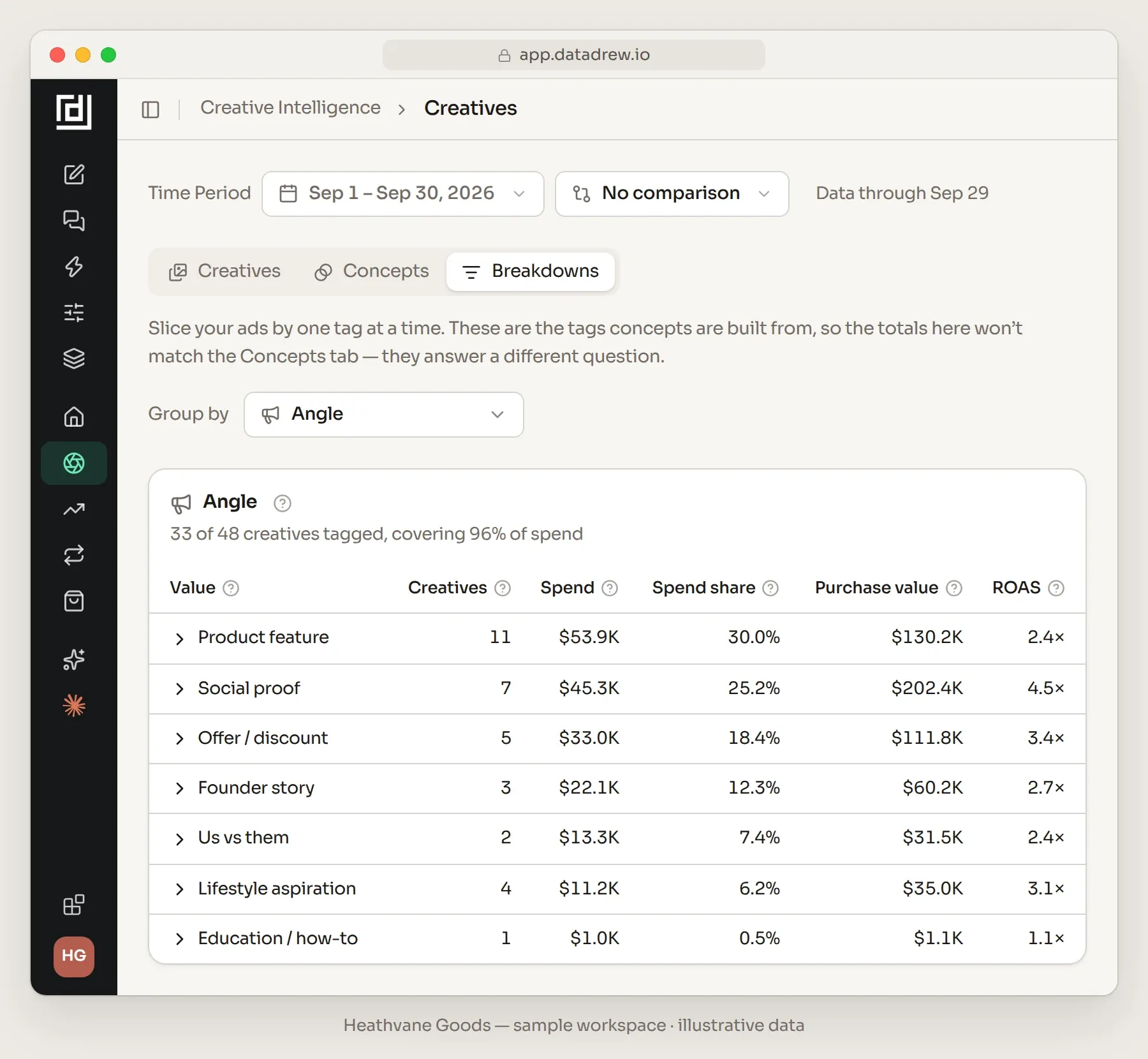
Now read one result at the right level. Group the sample account by angle and product-feature ads carry 30.0% of tagged spend at 2.4× ROAS (Meta-reported), under the account's 3.1×. Tempting to write the argument off. Check its two concepts first: product-feature demonstrations return 3.4× on $24.2K, product-feature bold claims 1.6× on $29.7K. Demonstrating the feature works. Asserting it doesn't, and the assertion has the bigger budget.
Then set expectations. Motion's benchmarks put winners at “roughly five percent” of ads, counting a winner as an ad that spends at least 10× its account's median, plus a small minimum spend. You'll lose most tests. The job is to lose them cheaply and learn at the right level.
When a winner starts to tire, iterate before you restart
At this spend, winners are consumables. Queue Level D iterations while the winner is still scaling. Wait until it's dead and you're briefing from a standing start while its budget drifts onto weaker ads.
In the sample account, Founder story 60s is the tired execution: frequency 3.1, $45.39 a purchase (Meta-reported). Its 15-second cut is the iteration, at $35.78 a purchase over 109 purchases, but at frequency 1.6, so some of that edge is freshness. Read it the Level D way: move budget to the cut while it has headroom under 2.5, and compare CPA again as its frequency nears the parent's. If it holds under $45, it's the new lead. If its CPA climbs to meet the parent's, the concept is tiring too, and the next test is a new angle or persona.
That's the general rule: the level that died decides the brief. Fatigue at four levels shows how to tell which one died; the ad creative brief template has both the iteration and the new-concept brief.
How many new concepts must enter testing each week
Almost no testing guide asks this, yet it decides whether next month's spend sits on fresh winners or tired ones. Three lines of math:
- → Live winners you need = spend you want on winners ÷ what one winner carries a month
- → Winners you lose a month = live winners × (4.33 ÷ weeks a winner lasts)
- → Tests a month = winners lost ÷ hit rate
On the sample account, the team wants about 42% of its $186,400 on proven winners, roughly $78,000, and one winner carries about $26,000 a month. So it needs 3 live winners. If each lasts about four weeks, it loses about 3.2–3.3 a month. At a 10% hit rate that's about 32–33 real tests a month, 7–8 a week. A real test changes one of the four levels. A recolor doesn't.
Now hold that against the month priced earlier: 25 new ads, seven or eight short. At 10%, that's roughly two missing winners a quarter, and their budget lands on tired ads. Closing the gap with hook reads costs $490–$560 but only finds winners on concepts that already work. Closing it with concepts costs $6,700–$7,700 and takes testing to about 12% of spend. Most teams need a bit of both.
Run your own numbers in the creative demand planner. Creative-led scale is one of the six forms of scale in scaling paid ads profitably, and this math keeps it fed. For fatigue, briefs, hook rate and competitor ads, the full creative performance guide for Shopify brands has a chapter on each.
How Drew fits. Datadrew grades your Meta creatives on the same evidence line: a creative waits for 15 purchases and 5 delivery days (one with zero purchases after 3× your account's median cost per purchase doesn't wait for 15). Fatigue is a two-condition test against each creative's own baseline, and each graded creative maps to Scale, Iterate, Kill or no action, with the numbers behind the call. The Concepts view groups near-identical creatives so you see how many ideas you're really testing; Breakdowns slices performance by angle, hook type, visual hook device, tone, offer or production style, one tag at a time. Both cover the creatives Datadrew has read (the ones carrying real spend), and the page states the coverage. Grading, Concepts and Breakdowns are on paid plans; the free plan lists your creatives with their metrics.
Drew, the AI analyst inside Datadrew, answers the same questions in conversation and can cross angle × hook. It doesn't pick your concepts or make the ads. Ask whether a result speaks to the hook or the concept and it answers from your numbers, then writes the next brief as text. When a creative should be paused or a winner fed, Drew proposes the change as a recommendation card; approving cards to apply changes is rolling out, so what you can apply depends on what's enabled for your account. Data is daily and Meta-reported, and labeled that way. See how creative strategy works in Datadrew.
Key Takeaway
A Meta ads creative testing framework works when each test changes one level and is read on that level's evidence. Test concepts first and graduate one at 15 purchases at or under target CPA. Then test three structurally different hooks on it (read on hook rate from about 5,000 impressions each), queue iterations before the winner tires, and widen to a new angle or persona when its frequency climbs. Budget 15–20× target CPA per concept, and plan volume backwards from the winners you lose: at a 10% hit rate, three live winners lasting four weeks need about 32–33 new tests a month, 7–8 a week.
Frequently Asked Questions
How should a Shopify brand structure creative testing on Meta: concepts or hooks first?
Concepts first. A hook decides how many people stop scrolling, but it can't rescue a weak reason to buy. Launch 4–8 genuinely different concepts, graduate one at 15 purchases at or under target CPA, then test three structurally different hooks on it. If all three miss target CPA with enough delivery, stop hook-testing and brief a new concept.
How many new creatives should we test each month on Facebook and Instagram?
Work backwards from winners: live winners you need × (4.33 ÷ weeks a winner lasts) ÷ your hit rate. Three live winners that each last about four weeks, at a 10% hit rate, need about 32–33 new tests a month, 7–8 a week. Count a new concept, angle or persona, hook or cut of a winner as a test. Recolors don't count.
How much of our Meta budget should go to creative testing?
Most published guidance says 10–20% of Meta spend, but sizing it from your CPA is more useful: 15–20× target CPA per concept, about 5,000 impressions per hook read and about 10× target CPA per iteration of a proven winner, which usually buys its 15 purchases. For a sample account spending $186,400 a month at a $48 target CPA, a full month of tests costs about $15,000, roughly 8% of spend.
Should creative tests run in a separate campaign or inside Advantage+?
Price the separate lane first: the concepts you need a month × 15–20× target CPA. If that's more than about 15% of monthly Meta spend, test inside your main campaign, Advantage+ or otherwise, and treat low spend as unproven, because a starved ad and a weak ad look the same at first. If it's less, run concepts in a dedicated lane for cleaner reads and test hooks and iterations inside the main campaign. For a big either-or question, Meta's A/B test in Experiments compares up to 5 versions with a randomized split, so nobody sees more than one.
How long should a creative test run before we call it?
Until the evidence exists, which is rarely a fixed number of days. A CPA verdict needs 15 purchases and at least 5 delivery days; a hook read needs about 5,000 impressions. The one early exit is a concept that has spent about 3× target CPA with zero purchases. How long to test Facebook ads sets out the data floors in full.
What hit rate should we expect from new ads?
Plan on about 10%, the planning number Ash Melwani of Obvi uses, and treat it as generous. Motion's 2026 benchmarks, which count an ad as a winner when it spends at least 10× its account's median plus a small minimum spend, put winners at 7.3% of creatives for accounts spending $50K–$200K a month on Meta and 8.1% at $200K–$1M. Most new ads lose, so price each test to lose cheaply and read each loss at the level it tested.
Written by Sumit Bansal, co-founder of Datadrew. Published 30 September 2026. Meta platform facts checked against Meta's Help Center and Meta Engineering on 30 September 2026. Worked examples use a sample account with illustrative numbers; third-party figures link to their sources. Datadrew deals in realized numbers with Shopify orders as the source of truth; we don't adjudicate which channel or creative deserves credit for a sale.