Creative performance for Shopify ads: what to test, when to refresh, what to make next
“winner fatigued in 7-10 days. the succession plan was hope.”
A FOUNDER'S LINE FROM OUR OPERATOR RESEARCHFor Shopify founders, CMOs and growth leads at $5M–$50M+ GMV running Meta at real spend. Winning ads are consumables now: they tire in weeks, sometimes days, and few new ads ever become winners. When one dies, most brands have no tested successor, no record of why it won, and nobody whose job is turning the numbers into the next brief. Chris Thomas of Silvertip Digital, on UK accounts: “A creative that started at a 1.4% CTR and a £22 CPA will, on most accounts above £50k a month, hit fatigue inside seven to ten days now.” Below: a symptom router, the cycle, the four levels, the data boundary, a demand planner and a worked example.
YOUR OWN BASELINES Every read here compares a creative with its own history and your account's averages, not an industry benchmark. Meta-reported numbers are labeled that way, Shopify orders are the scoreboard, and data is daily, not real-time.
Ten creative problems, and where each one is answered
Pick the question you'd type at 11pm.
It's fatigue only when two signals move together for a week: frequency leads, CTR confirms, cost per result lags.
WHICH SIGNAL MOVES FIRST → It stopped working. Is it even fatigue?Often not: a broken page, a stock-out, a margin change, the auction or an edit you forgot can all pass for a tired ad.
FATIGUE OR ONE OF FIVE IMPOSTORS → Is it the ad, the concept, the audience or the offer that's tired?Four levels with four very different bills, so check the offer, then the audience, then compare siblings.
FATIGUE AT FOUR LEVELS → What do we test first: new concepts or new hooks?Concepts, because a sharper hook can't rescue an idea nobody wants.
THE TESTING FRAMEWORK → How long do we give a new ad before we judge it?Until it clears four floors (5 delivery days, 1,000 impressions, 100 link clicks, 15–20 purchases), and most ads never do.
HOW LONG TO TEST → Look at our winners and tell me what to brief next.From what already won, with the brief type set by the level that tired: iteration or new concept.
THE BRIEF TEMPLATE → Our hook rate looks fine but sales don't. What are we missing?Hook rate grades only the first three seconds, so if hook and CTR hold while conversion falls across ads, check the page, price and stock.
HOOK RATE, EXPLAINED → What are competitors running, and should we care?The Ad Library shows what they run and since when, never what it earns, so brief the gap, never their ad.
READING COMPETITOR ADS → How many new ads do we need to make next month?Winners you need, how long they last and your hit rate give the monthly and weekly number.
THE DEMAND PLANNER ↓ Can I ask Claude or ChatGPT about my ad creative?Yes, once an MCP connection brings in your Meta data; the post shows it in Claude, with eight prompts and five status buckets.
CREATIVE ANALYSIS IN CLAUDE →Six steps from research to retirement, and the two most teams skip
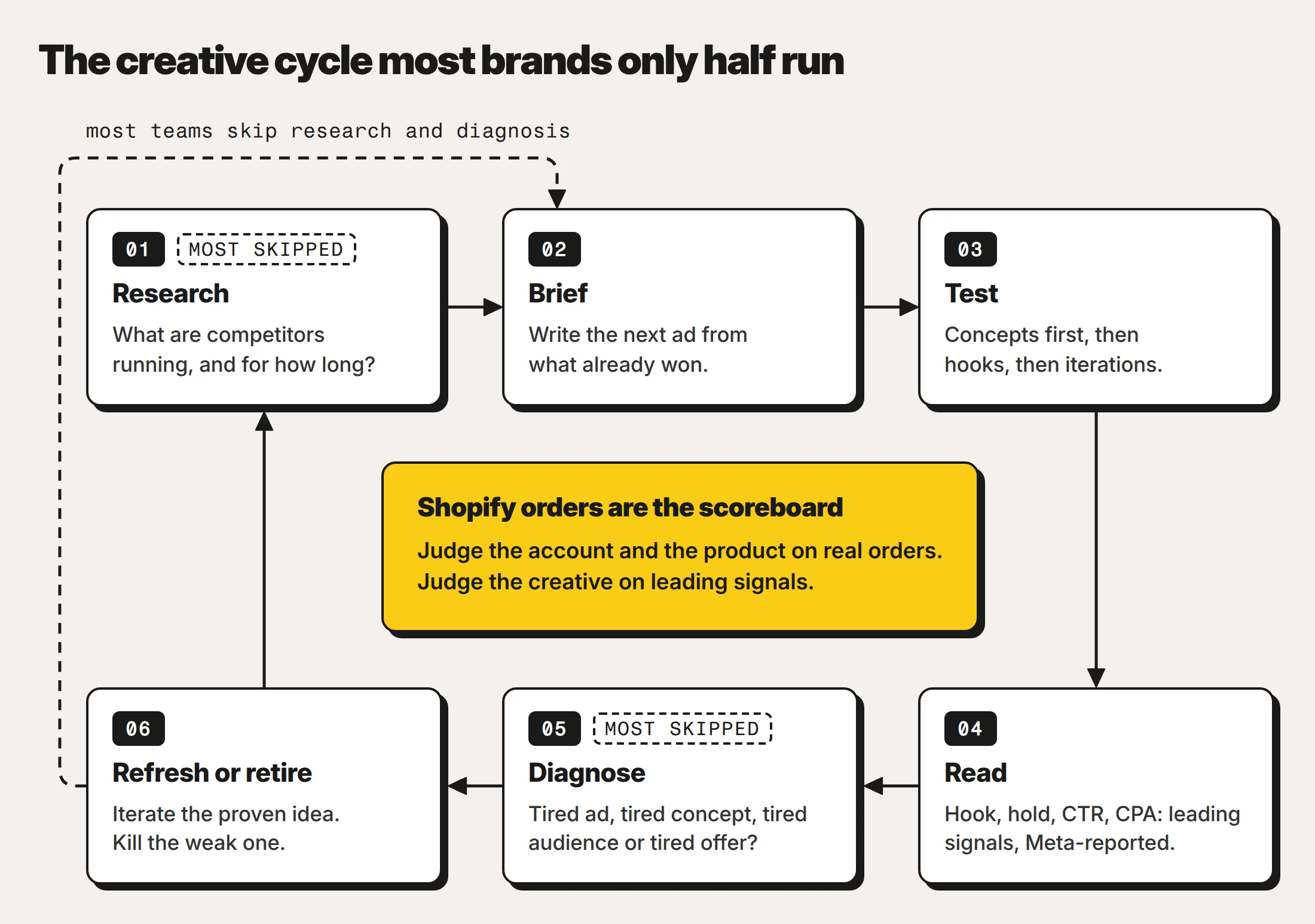
Most brands run half of this cycle: brief, test, read, brief again. You know the drill. What falls out is the research that should feed the brief and the diagnosis that should decide what the next brief is for, so the team ships plenty of ads and learns very little from them.
-
Research
Thirty minutes a week in Meta's Ad Library, five rivals per market you sell in. An ad live 30+ days survived the cull, and that's all the date proves. You're hunting for messages they keep running that you have no answer to. Reading competitor ads without guessing.
-
Brief
Write it from what already won: the hook, angle, format and product that worked, and the evidence behind them. Pick the brief type first. An iteration brief keeps a proven concept and changes the opening; a new-concept brief changes the reason to buy. The brief template, with a filled example.
-
Test
Concepts before hooks, hooks before iterations. A concept graduates at 15 purchases at or under target CPA; the one early exit is zero purchases after about 3× target CPA. The switching rules live in the testing framework, the data floors in how long to test.
-
Read
Hook rate, hold rate, link CTR and CPA: leading signals, all Meta-reported, each read against the creative's own history and your account median for the same format. Hook rate and hold rate, explained.
-
Diagnose
Confirm fatigue with two signals moving together, never one. Then find the level: the ad, the concept, the audience or the offer. Fatigue at four levels and which signal moves first.
-
Refresh or retire
Refresh when the concept still sells and one execution is tired: new opening, same idea. Retire an ad that's tired and under your ROAS floor, and the whole idea when every version falls together. The freed budget goes to what's working, and the next brief starts back at research.
Creative wins and dies at four levels. Diagnose the wrong one and you lose a month.
A creative concept is the idea an ad sells: its angle and core promise, separate from the execution. One concept can run as dozens of ads, hooks, creators and formats. So when the numbers slide, ask what's tired: the ad, the idea behind it, the people seeing it or the offer it points to.
Guess wrong and you pay twice. Re-cut an ad when the concept is spent and you buy two more weeks at a bad CPA. Ship new creative when the offer stopped landing and nothing changes at all.
| Level | What you see | What to do | What it costs | Go deeper |
|---|---|---|---|---|
| Ad the execution | One version tires while its siblings on the same idea hold | A new opening or first frame on the same concept | Cheapest: a re-edit, days | Iterations, four levels |
| Concept the idea | Every version of the idea falls together; new cuts open weaker than the ones they replace | A new-concept brief | A new shoot, weeks | The brief template, four levels |
| Audience or market | Unrelated concepts fade in the same audience, market or placement; frequency climbs across ad sets | A new audience truth, a new market, or accept the ceiling | Medium | Four levels, the scaling ceilings |
| Offer or product | Hook rate and CTR hold, but conversion or order value falls across ads | Fix the offer, price, stock or page; new creative won't help | Cheap to check | Four levels, product performance |
Diagnose cheapest check first: rule out the impostors, then check the offer, then the audience, then compare siblings. Test biggest unknown first: concepts before hooks, hooks before iterations, and a new angle or persona to widen a concept that has already won. A failed hook doesn't sink the concept above it. The testing framework has the switching rules.
The four levels are method, a way to read numbers you already have. No tool stamps a level on your account.
What creative data can tell you, and what it can't
Creative metrics are engagement plus Meta-reported conversions. The purchases, CPA and ROAS on a creative are Meta's own attribution: a useful leading indicator, counted by Meta's rules.
Any sales number pinned to a single creative is attribution: Meta's model, or a tracking tool's rules, deciding who gets credit. Datadrew doesn't join ad clicks to Shopify orders, so we won't hand you revenue, LTV or CAC per creative and call it fact. Rank the leading indicators; bank the Shopify orders.
| The question | What answers it | Where to read it |
|---|---|---|
| Is this ad stopping the scroll? | Hook rate: 3-second plays ÷ impressions, as Meta defines it. Hold rate: 15-second plays ÷ 3-second plays | Against the creative's own history and your account median. Hook rate, explained |
| Is it still selling, on Meta's read? | Link CTR, CPA and Meta-reported ROAS against the creative's own baseline and your account average | Your creative table, sorted by spend |
| Is the business making money? | Shopify orders against total ad spend across Meta and Google (blended MER), and marginal ROAS on the last budget step | Scaling paid ads profitably |
| Which products are carrying the ads? | Shopify orders by product, next to the ads that feature each product | Product performance management |
| Which creative brought in our best customers? | Not answerable from creative data: purchases per ad are Meta's attribution, not a record of who bought again | Product-level repeat behavior instead, from Shopify orders by product |
How many new ads you need next month: the creative demand planner
Winners don't last, and only a small share of new ads ever become one. So stop asking whether this week's ad is good. Ask whether enough new creative is entering testing to replace what's tiring. Most teams find out the week the winner dies and the bench is empty.
The math fits in three lines:
- Live winners you need = spend you want on winners ÷ what one winner can carry a month
- Winners you lose a month = live winners × 4.33 ÷ weeks a winner lasts
- New ads to test a month = winners lost ÷ hit rate
The hit rate is the humbling part. Ash Melwani, CMO of Obvi: “Assume that you will have a 10% hit rate on all the new ads you test.” And on volume: “If you're testing 10 ads a week, you can expect MAYBE 1 to hit. If you test 50 ads a week, your odds are finding a winner are way better.”STAY.AI INTERVIEW, ARCHIVED COPY (THE SITE IS OFFLINE)
Creative demand planner
Five numbers from your own account. Output: how many new ads must enter testing each month and each week.
The 10% default is Melwani's planning assumption. Motion's Creative Benchmarks 2026 (578,750 creatives, $1.29B of Meta spend) put spend-defined winners at 3.7%–8.2% of creatives by spend tier, so 10% is generous if you count every ad you launch. Take weeks a winner lasts from your own last five winners; Chris Thomas's seven to ten days is one operator's read for UK accounts above £50k a month. The planner runs on your inputs only: no account access, no benchmarks.
A worked example: an $18M Shopify brand with 48 live ads and only six ideas
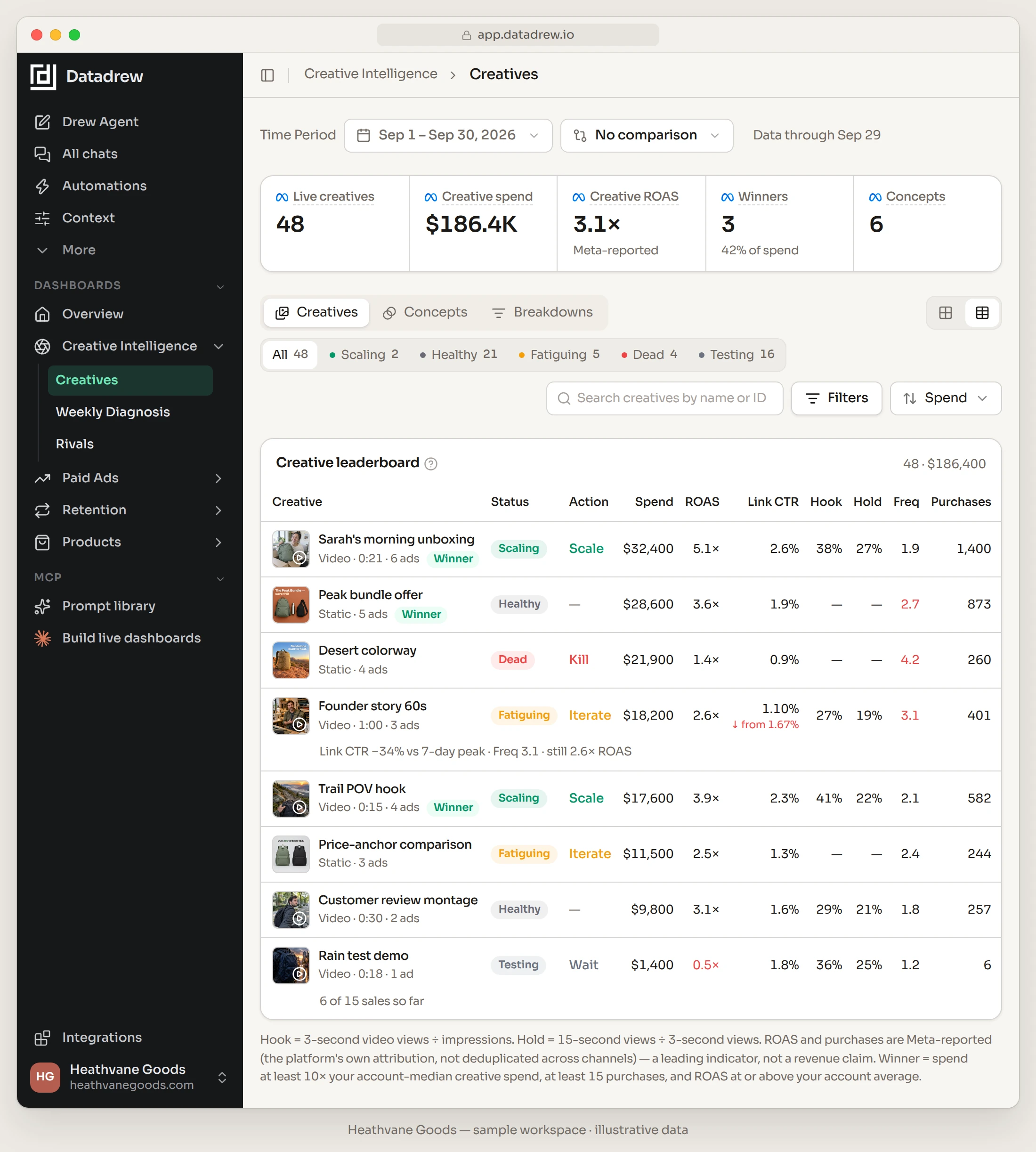
Heathvane Goods is a sample account with illustrative numbers: a Shopify brand selling daypacks and slings at about $18M GMV, with $186,400 on Meta in the last 30 days. Its 48 live creatives turn out to be six concepts. Account ROAS is 3.1× (Meta-reported); target CPA is $48. There's no creative strategist: the founder, a head of growth, one media buyer, a designer-editor and about eight UGC creators share the job.
| What we looked at | What it showed | The call |
|---|---|---|
| Winners | 3 winners carry 42% of spend. Sarah's morning unboxing runs at 5.1× with frequency 1.9 and link CTR at its peak. | Scale it while it has headroom |
| Ad level | Founder story 60s: link CTR 1.67% → 1.10% (−34%) at frequency 3.1, still 2.6× against a 2.3× floor. Its 15-second cut holds at 3.3×. | Iterate the opening, keep the concept |
| Concept level | The Bold claim concept (the Desert and Waterproof statics) sits at 1.6× while the other five concepts run 2.4×–4.5×. Desert colorway's 7-day CPA is 58% above its own baseline, at frequency 4.2 and 1.4×. | Kill Desert colorway; brief a new concept instead of another re-cut |
| Research | Three rivals, all fictional. Durability carries 3 of the 5 rival ads tagged, both of Quillridge's among them, and no Heathvane concept leads with it. | The new-concept brief: “Durability, proven”, built on the lifetime-repair promise |
| Supply | 3 winners lasting about 4 weeks means about 3.2–3.3 to replace a month. At a 10% hit rate that's about 32–33 new ads a month, 7–8 a week (the planner shows 33). | The planner number the team now works to |
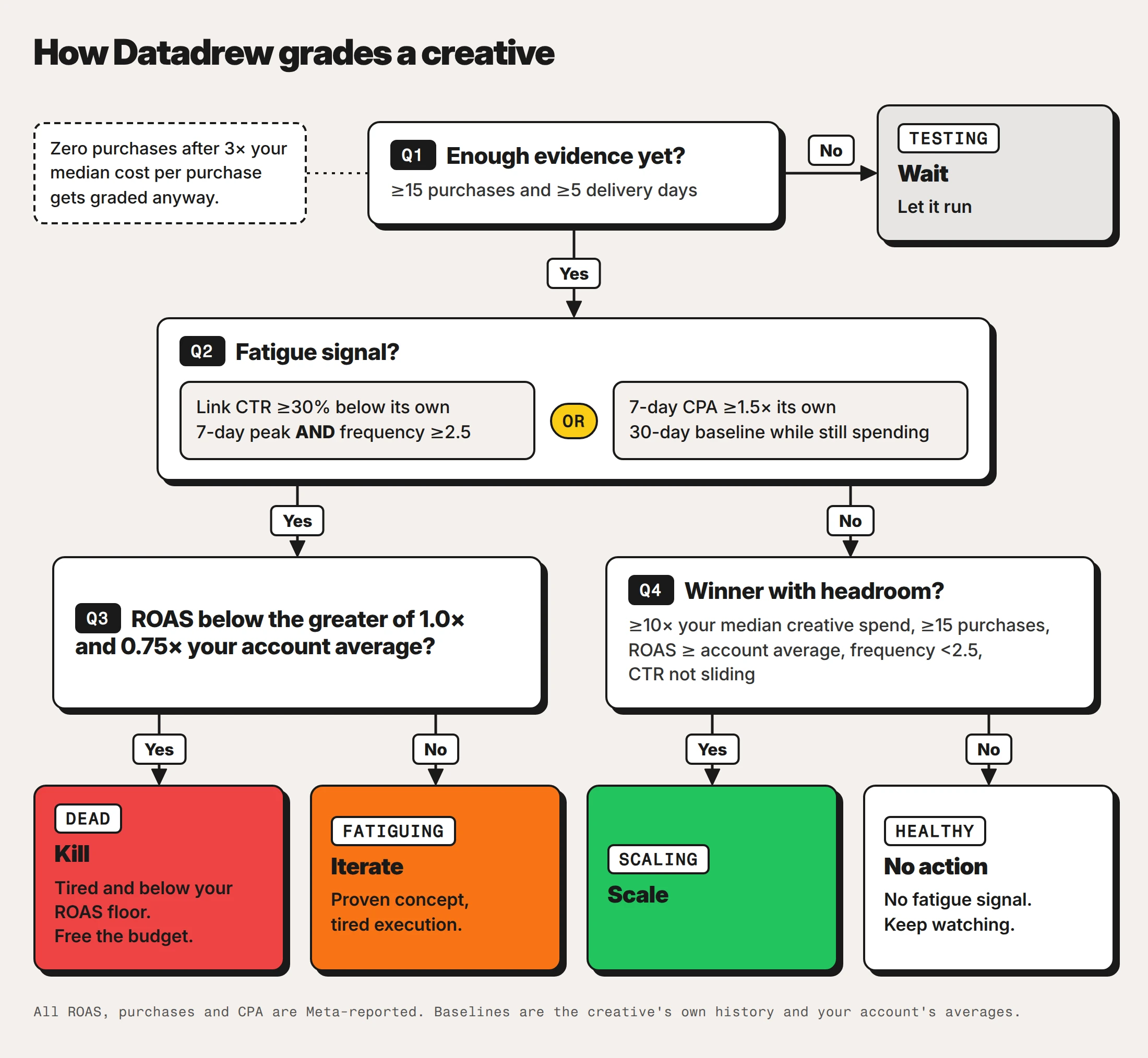
Sample account, illustrative data. ROAS, CTR and CPA are Meta-reported. The verdict rules are the ones in the grading diagram below.
Add it up. The week's three calls put $72.5K of spend on a decision (Scale $32,400 · Kill $21,900 · Iterate $18,200), and none of them needed a revenue-per-ad number.
Run this read on your own Meta account: connect Shopify and Meta, and Drew grades each creative against its own baseline, names what to scale, iterate or kill this week, and writes the next brief as text. Free to install; grading is on paid plans.
Grade your own creativesWho owns creative at a $5M–$50M brand (often the founder, at 11pm)
One seam in this cycle rarely has an owner: reading performance and turning it into the next brief. The media buyer reads the numbers. The creative team reads the brief.
At brands that staff it, it's a real hire. O Positiv's Creative Strategist listing in Santa Monica (ZipRecruiter, re-posted in September, as read on 30 September 2026) pays $100K - $125K/yr to turn creative concepts into detailed briefs for the design, video and email teams, and to analyze ad performance across paid media and email to steer creative direction. In a LinkedIn post, Taylor Holiday, CEO of Common Thread Collective, put the median US creative strategist's pay at $115K.
Many $5M–$50M brands never make that hire. The job still gets done, usually in one of three setups:
- The founder or head of growth, at 11pm. Best product knowledge, least time, and the brief is a Slack message.
- A media buyer and a designer who don't share a screen. One sees the numbers, the other sees last week's brief, and the learning never crosses the gap.
- An agency. It can run the read well, and its learnings leave with the account.
The job in one week, whoever holds it:
- Monday, 30 minutes: what your rivals launched and stopped in the last 7 days.
- One read of the creative table against each creative's own baseline.
- One diagnosis at the right level: ad, concept, audience or offer.
- One to three briefs, each marked iteration or new concept.
- Once a month: the planner number, checked against what the team actually shipped.
Somebody has to own it by name, even if that somebody is you.
What Drew does with this, and what it doesn't do yet
Datadrew's Creative Intelligence section grades each Meta creative against its own history and your account's averages, one row per creative, into five states with one call each: Scaling → Scale, Healthy → no action, Fatiguing → Iterate, Dead → Kill, Testing → Wait. The numbers that triggered each call sit next to it, and the same rules run in the dashboard and in Drew's answers. A creative waits until it has 15 purchases and 5 delivery days.
Then ask in plain English: “Is it the ad or the concept?” “What should we brief next?” Drew answers in the app, in Slack, or from Claude or ChatGPT through MCP. For the business view it reads your Shopify orders and blended efficiency across Meta and Google next to the grades, against the margins you share with it. Creative data is daily, through yesterday.
Creative grading for Meta
Five states and a call on each creative, with the numbers attached. Verdicts are on paid plans; the free plan lists creatives with their metrics.
Fatigue detection
Two signals on the creative's own baseline, never one: link CTR 30% or more below its 7-day peak with frequency 2.5+, or 7-day CPA 1.5× its 30-day baseline while spending.
Weekly Diagnosis (paid)
A page you open: up to three Scale, Iterate or Kill calls ranked by the spend behind each, and an honest “nothing needs action” state.
Concepts and Breakdowns (paid)
The ideas behind your ads with their spend share and Meta-reported ROAS, and performance by angle, hook, tone, offer or production style, one tag at a time; coverage is stated on the page.
Rivals and Competitor Watch
Competitor ads from Meta's public Ad Library, per market: one brand on the free plan, up to five on paid plans; a Monday email, by default, of what they launched and stopped. No spend or results, because Meta publishes none.
Briefs from Drew, as text
Iteration briefs, new-concept briefs, UGC scripts and A/B variants that change one element, built from what already won.
Acting on the call
Drew proposes pause and budget changes as cards you approve; applying them from Datadrew depends on what's enabled for your account.
Making the ad
Drew doesn't generate images or video. Your team or creators make it; Drew tells you what to make and why.
See the creative strategy page, how Drew works, or pricing.
Creative questions Shopify operators actually ask
Know which creative to scale, iterate or kill this week
The router, the cycle, the four levels and the planner are yours to run by hand. Drew runs the same read on your own Meta account, on data refreshed daily and against your own baselines, and writes the next brief as text. Free to install; grading is on paid plans.
Book a demo