"my winner is dying and i genuinely don't know what to make next."
That's a line founders say, from our research (unattributed), and the reflex that follows is "make new ads". Say you've done the homework. The product page loads, the hero SKU is in stock, margins and the auction haven't moved, and tracking still matches Shopify orders. None of the five impostors in our fatigue-or-impostor diagnostic explains the drop. It's creative fatigue.
Now the expensive question: which level died?
Creative fatigue happens to an ad, a concept, an audience or an offer, and the fixes don't overlap. Re-cut the ad when the concept is spent and you buy two more weeks at a bad CPA. Ship new creative when the offer stopped landing and nothing changes.
This is for Shopify founders and growth leads at $5M–$50M GMV, usually with nobody whose full-time job is reading creative data. It's one chapter of our creative performance hub. If you're not yet sure the winner is tired, start with which fatigue signal moves first.
Key Takeaways
- → Creative fatigue happens at four levels: the ad, the concept, the audience or market, and the offer or product. Each has its own evidence, its own fix and its own price tag.
- → Check in the order that saves money: impostors first, then the offer (cheap to check, no creative needed), then the audience, then ad versus concept.
- → One execution tiring while its siblings hold is an ad problem: re-cut the opening and keep the concept. Every version sliding together, with new cuts opening weaker, means the concept is spent and needs a new brief.
- → The wrong level is expensive. On a sample account spending $186K a month on Meta, two more weeks of re-cutting a spent concept instead of briefing a new one costs about $4,700 over target CPA.
Creative fatigue is four problems with four different fixes
Some guides call the tired execution "ad fatigue" and the tired idea "creative fatigue". Others flip the two. Skip the labels and name the level, because the level decides the fix.
Connor Rolain, Head of Growth at HexClad, put the usual mistake in one line on Motion's blog: "Most brands keep changing how ads look but not what they say." Changing how an ad looks fixes the ad level. Changing what it says fixes the concept. Neither does a thing for an audience that has already heard the pitch, or for an offer that stopped being worth the click.
- → The ad is one execution: a cut, an opening, a first frame, one creator's take.
- → The concept is the idea every version shares: the angle and the claim, what the ad says.
- → The audience or market is where it runs: the people, the country, the placement.
- → The offer or product is what they're asked to buy, at what price, with what stock, on which page.
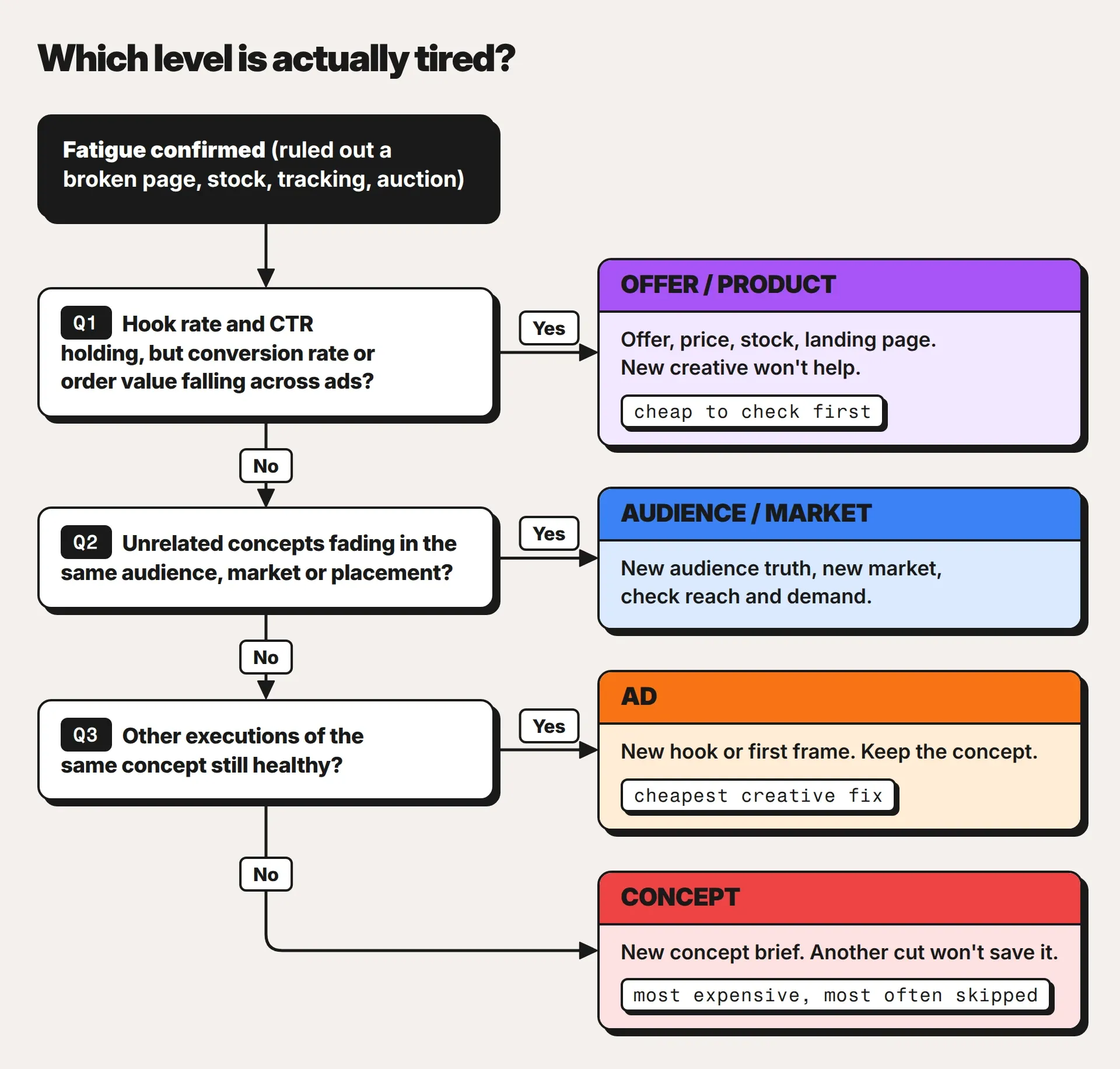
| Level | What you see | The fix | What the fix costs | The wrong fix teams reach for |
|---|---|---|---|---|
| Ad (the execution) | One execution tires while its siblings hold | A new hook or first frame; keep the concept | Cheapest: a re-edit, days | A whole new concept |
| Concept (the idea) | Every version of the idea declines together; new cuts open weaker than the ones they replace | A new-concept brief | Expensive: a new shoot, weeks | Another re-cut |
| Audience or market | Unrelated concepts fade in the same audience, market or placement; frequency climbs across ad sets | A new audience truth or a new market; check reach and demand | Medium | New creative for the same tired people |
| Offer or product | Hook rate and CTR hold, but conversion or order value falls across ads | Fix the offer, price, stock or page | Cheap to check; may be free to fix | Any new creative |
Read the cost column twice. The cheapest creative fix and the most expensive one sound the same in a Monday meeting, because both get called "make new ads". One takes your editor days; the other takes a shoot and weeks. And the offer row doesn't need an editor at all.
Ad-level fatigue: one execution tires while its siblings hold
Ad-level fatigue is the cheap one, and the one to hope for.
First, prove the execution is tired and not just having a bad week. We use a two-condition test against the creative's own history, and either pair fires it:
- → Link CTR at least 30% below its own best 7-day window, with frequency at 2.5 or higher.
- → Or cost per purchase over the last 7 days at 1.5× its own 30-day baseline or worse, while it's still spending.
A CTR dip alone never counts. Neither does a frequency number alone. Meta publishes no frequency threshold for fatigue, so the 2.5 is ours; move it if your own history argues for a different line, but keep two conditions.
Then look sideways. If other executions of the same concept (a shorter cut, a different creator, another opening) pass the same test cleanly, the idea still sells. Only the execution is tired.
Take a sample account (illustrative numbers). Heathvane Goods, a fictional Shopify brand selling daypacks and slings at about $18M GMV, spent $186,400 on Meta in 30 days across 48 live creatives but only 6 concepts. Account ROAS is 3.1× (Meta-reported) and the target CPA is $48.
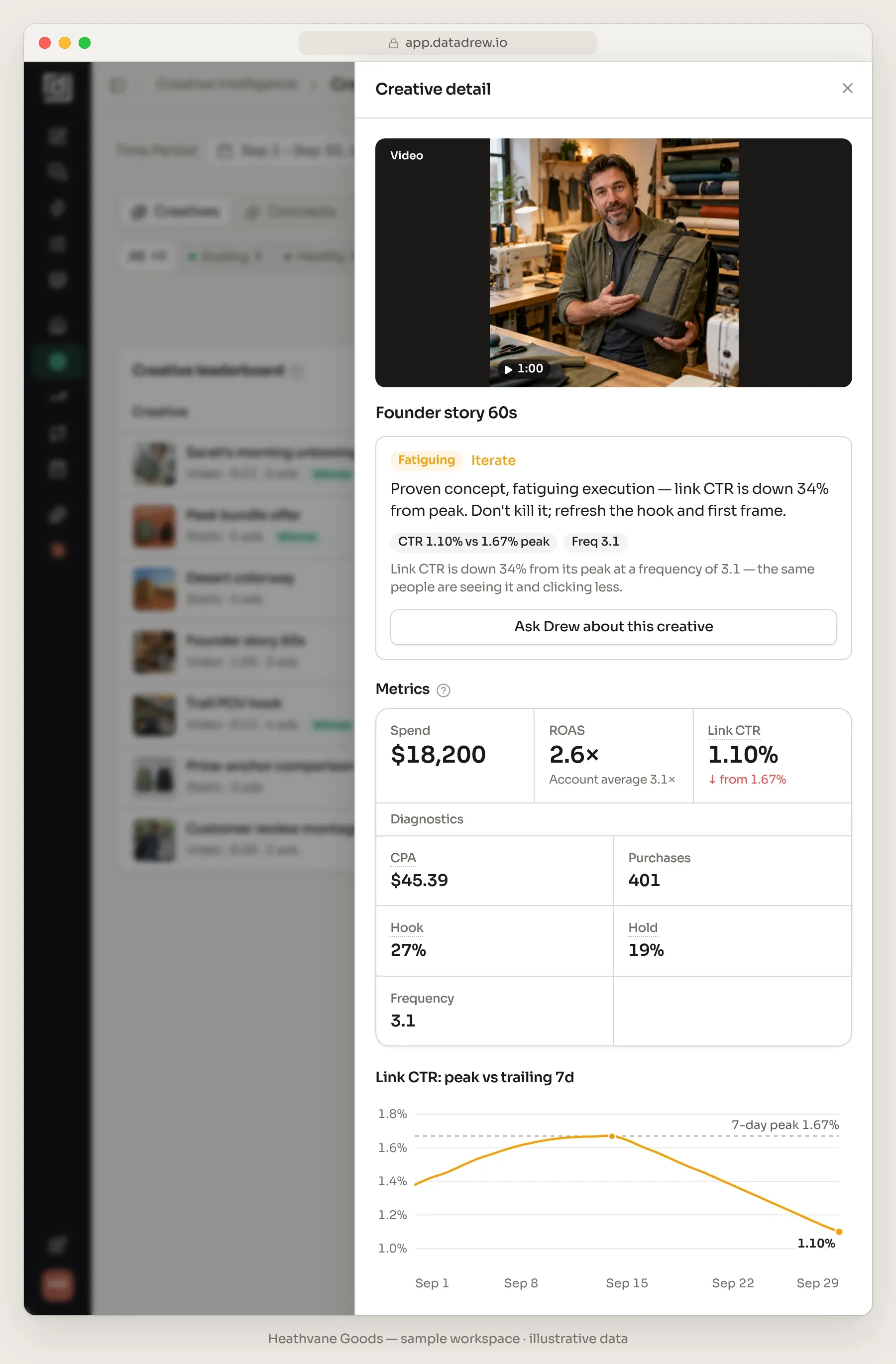
Its Founder story 60s video slid from a 1.67% link CTR at its 7-day peak to 1.10%, down 34%, at a frequency of 3.1. Both conditions fire. But it still returns 2.6× ROAS, above the account's 2.3× dead line (the greater of 1.0× and 0.75× the 3.1× average). The 15-second cut of the same story is healthy: 3.3× ROAS, 1.7% link CTR, frequency 1.6.
So iterate the opening and keep the concept. Brief a new first three seconds and first frame on the same story, and leave the 60-second cut live while the new one earns delivery. It's a Tuesday-afternoon job for your editor.
One check before you brief. The 15-second cut sits at frequency 1.6, so repetition hasn't tested it yet. If its CTR slides the same way once its frequency passes 2.5, you're looking at the concept after all.
Meta's own flag is worth knowing, mostly for what it misses. Ads Manager shows a creative limited status when an ad's cost per result is above your past ads but under twice as much, and a creative fatigue status at twice or more (Meta Business Help Center).
Three limits. It's cost-based, so it arrives after you've paid for the decline. It's narrow: "This feature is only available for ad sets with one creative…", so a winner sharing its ad set with other ads never gets the label. And it says nothing about the concept, the audience or the offer.
Even Meta's fix is ad-level: a new ad with an image or video "materially different from the original creative", with the original left running because that "may maximize results". That's close to the iterate call.
Concept-level fatigue: every version of the idea declines together
Concept fatigue is the expensive one, and the one teams talk themselves out of. The evidence is a pattern across siblings, never a single row:
- → Several executions of the same concept weaken over the same dates.
- → Iterations launched on the concept open weaker than the versions they were meant to replace.
- → Other concepts in the account hold up over the same window.
The third point is the control. If every concept is sliding at once, go back to the offer and audience checks, because the idea isn't what changed.
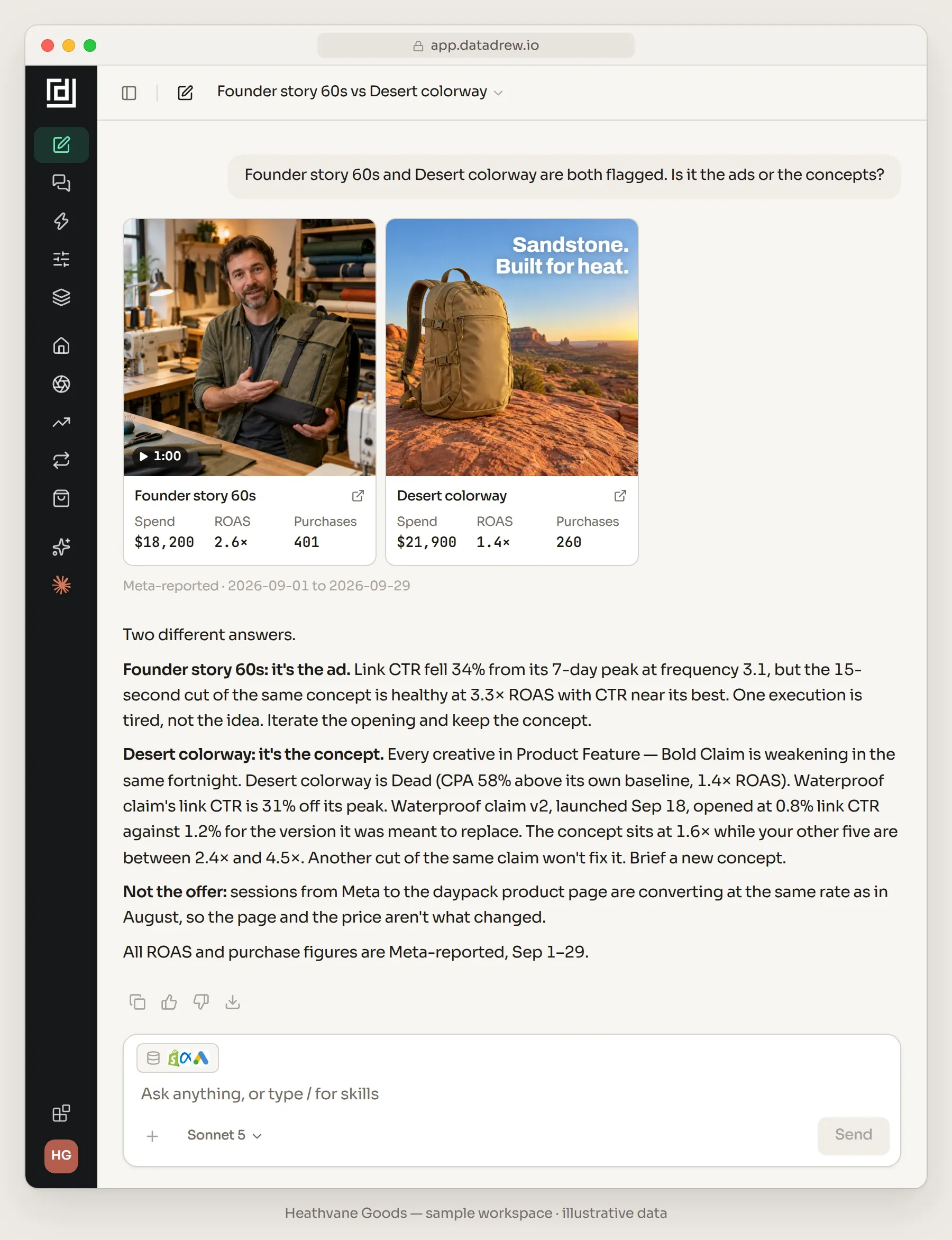
On the sample account, the "Product Feature — Bold Claim" concept (three statics) shows all three signs:
- → Desert colorway is Dead. Its last 7 days cost $133 per purchase against an $84 baseline, 58% worse, at frequency 4.2 and 1.4× ROAS.
- → Waterproof claim's link CTR is 31% off its peak. At frequency 2.2 that doesn't meet the test on its own, but it's heading the same way.
- → Waterproof claim v2, a re-crop launched Sep 18, opened at 0.8% link CTR against 1.2% for the version it was meant to replace. It hasn't earned a verdict yet (4 of the 15 purchases it needs), but an opening CTR a third below its parent is the tell.
The concept as a whole sits at 1.6× ROAS, under the team's 2.0× break-even. The other five concepts run between 2.4× and 4.5× over the same 30 days. Read one row at a time and you see one dead ad and two you'd leave alone. Read them together and the idea is spent.
So brief a new concept. Another crop of "Rain-proof. Proven." is the same claim in a new frame, which is exactly Rolain's point. A new concept changes what the ad says: a different reason to buy, a different problem, a different proof. It usually means a new shoot, so start the brief the day you see the pattern. Our creative brief guide covers what a new-concept brief needs that an iteration brief doesn't.
Audience or market fatigue: unrelated ads fade in the same place
Sometimes the ads are fine and the room is tired, which is what people mean by audience saturation. In the data it looks like this:
- → Several unrelated concepts soften in one ad set, country or placement over the same dates.
- → The same concepts hold in other ad sets or markets.
- → Frequency climbs across several ad sets at once.
- → Reach stays flat while spend rises, so extra budget buys repeat impressions.
- → New concepts start soft in that audience too.
On the sample account, which sells in the US and the EU, a hypothetical case would look like the testimonial, demonstration and founder concepts all sagging in the EU ad sets while they hold in the US. Three unrelated ideas failing in one place point at the place.
Don't settle it with the frequency column. Meta defines it plainly: "Frequency is calculated as impressions divided by reach. This metric is calculated using sampled data." (Meta Business Help Center) That's an average built on a sampled estimate. A frequency of 2.2 can be 80,000 accounts that saw the ad once plus 20,000 that saw it seven times. If those 20,000 are the people most likely to buy, the average hides exactly the audience that's tired. Read reach against spend across the whole account, and treat any single frequency number as a hint.
One branch isn't fatigue at all. If CPM rises while CTR holds, people respond as well as ever and you're paying more to reach them. That's the auction or the season. Our signal-or-noise guide covers when to sit tight.
The fix is a new audience truth, a new market or an honest ceiling. A new audience truth is a new angle for a different buyer ("parents who carry everything" instead of "weekend hikers"), run as the angle or persona test in our creative testing framework. A new market is the next country or placement these concepts haven't reached. And sometimes you've reached most of the people who buy this product at this price, so extra budget finds people who won't; our guide to scaling paid ads profitably covers where those ceilings sit. More creative for the same tired people won't help.
Offer or product fatigue: the ads still work, the sale doesn't
This is the level fatigue guides skip, and it's the one where new creative does nothing. The ads still stop the scroll and still earn the click. The sale stops after it.
The pattern: hook rate and CTR hold across executions while conversion rate or order value falls across all of them. If your team keeps saying the hook rate is fine but conversions dropped, our hook rate guide covers the attention side. The cause is usually one of these:
- → The same product page converting worse than it did a month ago, on the same traffic.
- → A price change, yours or a rival's, or a competitor promo that makes your full price look steep this week.
- → Sizes or colors running out, so the ad sells something the visitor can't buy.
- → A discount your audience has seen four times this year (what repeated discounts do to paid ads).
- → Order value slipping because a bundle or add-on changed.
None of these is a creative problem. Fix the offer, the price, the stock or the page. No hook sells a size you don't have.
It's also the cheapest level to check. Pull Shopify orders by product and sessions to the product page for the last two weeks against the two before. If conversion fell on the page while the ads held, you have your answer without briefing anyone. Our product performance hub, ad spend on out-of-stock products and add to cart but no checkout pick up from there.
On the sample account the offer check comes back clean: sessions from Meta to the daypack page convert at the same rate as in August, so the Bold Claim problem stays a concept problem.
The creative fatigue check, in the order that saves money
Run the levels in the order that costs least to check and least to get wrong. The order matters for a second reason: offer and audience problems drag every sibling down together, which looks exactly like concept fatigue. Rule them out first or you'll brief a new concept for a sold-out size.
- Rule out the impostors. A broken page, a stock-out, a margin change, an auction shift or a forgotten edit (the five impostors), plus a tracking check against Shopify orders. No creative decision yet.
- Check the offer and product. Shopify orders by product, conversion on the page, stock by size and color, price changes, promos. Cheap to check, and the fix needs no new creative.
- Check the audience and market. Compare unrelated concepts in the same audience, market or placement. All of them sagging in one place and holding elsewhere means the place is tired.
- Separate the ad from the concept. Compare siblings. One tired and the rest healthy: iterate the ad. All falling together, with new cuts opening weaker: brief a new concept.
Done by hand across 48 creatives, step 4 is a lot of spreadsheet gymnastics. Put the concept in every ad name and a pivot table does the grouping for you.
Along the way you'll meet eight signals. Each one leans toward a level, and none settles it alone.
| Signal | Usually points to | Check before you act |
|---|---|---|
| Sustained CTR decline | Ad or concept | One execution, or every sibling of the concept? |
| Higher CPM or less delivery while account conditions are stable | Audience, or the auction | Is CTR holding? CPM up with CTR flat is the auction or the season. |
| Rising frequency with a worsening response | Ad or audience | One ad, or several unrelated ads in the same audience? |
| Falling reach to new people | Audience | Reach against spend across the account, week on week |
| Worse CPA across comparable windows | Any level | Run the four checks in order before you touch the creative |
| Spend shifting away from the creative | Ad (Meta's own early read) | Where did the spend go: a sibling of the same concept, or another concept? |
| Several executions of one concept falling together | Concept | Are other concepts holding over the same dates? |
| Conversion falling | If site-wide conversion holds: concept or audience (the message and the audience don't match). If it falls site-wide: offer or product. | Conversion from these ads against conversion across the whole site |
And don't call every bad day fatigue. Before you name a level, compare the week against auction conditions, seasonality, what the site did, the edits you made and the product mix you pushed. A sale week, a price test or a new collection can move every number in that table without any creative getting tired.
What misdiagnosing creative fatigue costs at real spend
Now the bill for the wrong level, on the same sample account. The Bold Claim concept's three creatives spent $29,700 in 30 days for 410 purchases (Meta-reported): a $72 CPA against a $48 target.
- → At target, those 410 purchases should have cost 410 × $48 = $19,680.
- → The concept spent $29,700 − $19,680 = $10,020 more over 30 days, about $334 a day.
- → Two more weeks at that rate: 14 days × $334 ≈ $4,700.
That's the price of re-cutting the ad when the concept is spent, and two weeks flatters the re-cut. It takes days to make, then needs 15 purchases and at least 5 delivery days before you can read it (our evidence line; more in how long to test before a verdict). Heathvane is running that experiment now: Waterproof claim v2, the Sep 18 re-crop, still hasn't earned a verdict and sits at 0.8× ROAS.
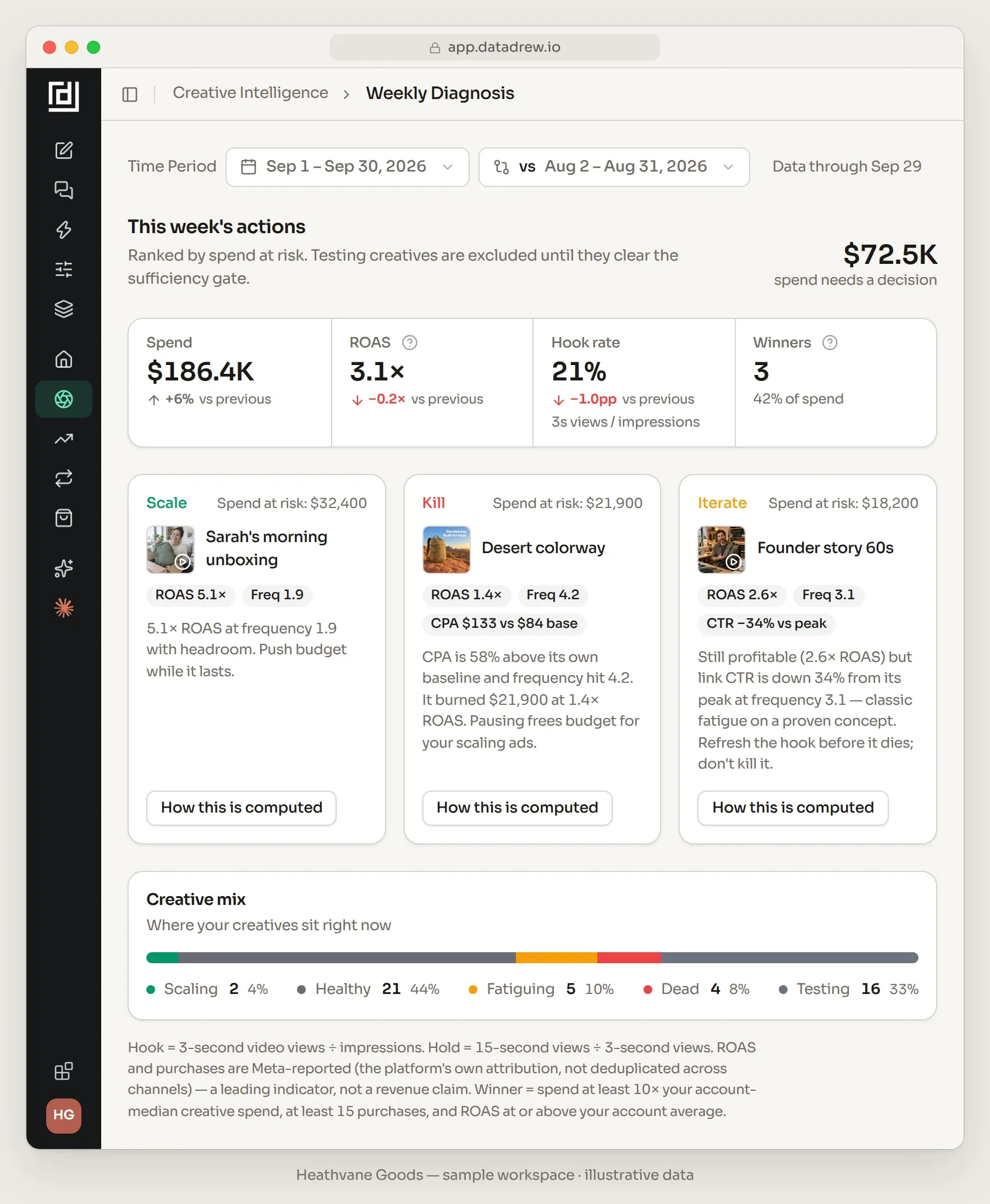
The right-level call is cheaper and faster. Pause Desert colorway, which the fatigue test already marks Dead, and put the new-concept brief into production the same day. Its budget can go to Sarah's morning unboxing, still at 5.1× ROAS at frequency 1.9, while the new idea gets made.
Rank your own calls by the spend riding on each. On the sample account, three creatives carry $72.5K of the month's spend. Two of those calls are fatigue at different levels: the Kill is the Bold Claim concept's biggest spender, the Iterate a tired opening on a concept that still sells.
One base rate keeps this honest. In Motion's Creative Benchmarks 2026 (578,750 creatives from 6,015 advertiser accounts and $1.29B of Meta spend, September 2025 to January 2026), about half of the creatives in every spend tier were turned off before they reached 28 days of spend: between 49.3% and 53.9%, depending on the tier (Motion's tier breakdown). A lot of what gets called fatigue is the early death of ads that never worked.
Fatigue needs a peak to fall from.
If a creative never reached its first 15 purchases, it didn't tire. It lost its test, so leave the four levels out of it. Save the diagnosis for creatives that earned real spend, and expect few: in the same data, winners were under 10% of creatives in every tier, and Motion counts a winner by the spend it earned, which says nothing about profit.
If losing a concept leaves a hole in next month's spend, the creative demand planner on our hub works out how many new ads need to enter testing each week.
How Drew fits. On paid plans, Datadrew grades each Meta creative against its own history and your account's averages, one row per creative. A creative that trips the two-condition test above becomes Fatiguing → Iterate (proven concept, tired execution) or, with ROAS below the greater of 1.0× and 0.75× your account average, Dead → Kill, with the numbers attached. The Weekly Diagnosis page lists up to three Scale, Iterate or Kill calls ranked by the spend behind each. The Concepts view groups near-identical creatives and shows each concept's spend and ROAS, so a spent idea stands out; the page states how much of your spend it covers.
Ask Drew "is it the ad or the concept?" and it compares siblings, concepts and placements, reads your Shopify orders by product alongside, and writes the iteration or new-concept brief as text; your editor or creators make the ad. Data is daily, and ROAS and purchases are Meta-reported and labeled so. Drew proposes pause and budget changes as recommendation cards; approving a card to apply the change is rolling out, so what's click-to-apply depends on what's enabled for your account. The free plan lists your creatives with their metrics. The four levels are method: Drew doesn't stamp a level on your account by itself. See how creative grading works.
Key Takeaway
Creative fatigue happens at four levels, and once a winner is confirmed as fatiguing, the job is to find the one that died: the ad, the concept, the audience or market, or the offer or product. Check in the order that saves money. Rule out the impostors, then check the offer (cheap, and no creative needed), then the audience (unrelated concepts fading in one place), then compare siblings. One execution tiring while its siblings hold means iterate the ad and keep the concept; every version falling together, with new cuts opening weaker, means brief a new concept. The wrong level costs real money: on a sample account spending $186K a month on Meta, two more weeks of re-cutting a spent concept costs about $4,700 over target CPA, and no new creative fixes a tired offer.
Frequently Asked Questions
My winner is dying and I don't know what to make next. Where do I start?
Confirm it's fatigue first: link CTR at least 30% below its own 7-day peak with frequency at 2.5 or higher, or recent cost per purchase at 1.5× its own baseline while it still spends, with the page, stock, tracking and auction ruled out. Then find the level before you brief anything. Check the offer, then the audience, then compare the winner with its siblings. If the siblings hold, brief a new opening on the same concept; if they're all falling, brief a new concept.
How do I know if the whole concept is fatigued, or just one ad?
Compare the executions that share the idea. If several weaken over the same dates, new cuts open weaker than the versions they replace and your other concepts hold, the concept is spent. If one execution is tired while a sibling passes the same test cleanly, it's the ad. Make sure the healthy sibling isn't just younger: one at low frequency hasn't been tested by repetition yet.
Is high frequency always a sign of creative fatigue?
No. Meta calculates frequency as impressions divided by reach from sampled data, so it's an average that can hide a small group that has seen the ad many times, and Meta publishes no frequency threshold for fatigue. High frequency means fatigue only when the response falls with it: CTR down from its own peak, or CPA up against its own baseline. If frequency climbs across several unrelated ads in the same audience, look at the audience before the creative.
Can an offer or a product fatigue, rather than the creative?
Yes. If hook rate and CTR hold across your ads but conversion rate or order value falls across all of them, the ads are doing their job and the sale isn't happening. Look at price changes, competitor promos, sizes and colors running out, the product page and discounts your audience has seen too often. New creative won't fix any of those.
Should I pause a fatigued ad or refresh it?
Refresh it if the concept still sells. A fatiguing ad whose ROAS is still above your floor (we use the greater of 1.0× and 0.75× the account average) is a proven concept with a tired execution, so brief a new opening and keep the old ad live while the new one earns delivery, which is also Meta's advice for its own fatigue flag. Pause it once ROAS drops below that floor, and brief a new concept if its siblings are falling too.
How long does a winning concept last on Meta?
There's no universal number. One practitioner's read comes from Chris Thomas of Silvertip Digital: "A creative that started at a 1.4% CTR and a £22 CPA will, on most accounts above £50k a month, hit fatigue inside seven to ten days now." (Silvertip Digital) That's one agency's view of accounts above £50k a month, and it describes a single creative; a concept with several strong executions can outlast any one of them. Watch the siblings and the fatigue test rather than the calendar.
Written by Sumit Bansal, co-founder of Datadrew. Published 30 September 2026. Meta platform facts checked against Meta's Help Center on 30 September 2026; Motion figures from its Creative Benchmarks 2026 report and tier breakdown, checked 30 September 2026. Worked examples use a sample account with illustrative numbers, and their ROAS and purchases are Meta-reported. Datadrew deals in realized numbers with Shopify orders as the source of truth; we don't adjudicate which channel or creative deserves credit for a sale.