"look at my winning ads and tell me what to brief next. what patterns matter — hook, format, angle?"
Our founder research turned up that question, lowercase and all. It's what Shopify founders and growth leads ask ChatGPT or Claude when a winner starts to tire. The instinct is right. Brief the next ad from what already won. The trouble is where the ad creative brief gets written.
At $5M–$50M a year, your team ships 20 to 60 new ads a month: a designer, an editor, five to fifteen UGC creators, maybe an agency. The media buyer reads Ads Manager. The creative team reads the brief, the only document between what your account has proved and what gets filmed. Most are written from a brand deck and a blank page by whoever had an hour free.
So creators go rogue or come back robotic. Edits get redone. Winners die with nothing queued behind them.
Here's what I'd hand that team instead: five evidence inputs, two brief types, a copyable template, a filled-in example and the decision rules to set before anyone shoots, all part of our creative performance hub for Shopify brands.
Key Takeaways
- → Write the ad creative brief from five inputs: what's winning and why, what's tiring and at which level, what the winning ad says, what competitors run that you have no answer to, and the business context (stock, margin, offer calendar).
- → Pick the brief type first. A tired execution gets an iteration brief: same concept, new first 3 seconds. A tired concept gets a new-concept brief. Never mix the two.
- → Put the decision rules in the brief before production: where it runs, spend to a verdict (15–20× target CPA), the metric that reads it, the iterate line and the kill line.
- → Brief UGC creators with beats and three filmed openings per video, and agree usage rights and whitelisting before the shoot.
Why most ad creative briefs fail before anyone presses record
A bad ad is usually a bad brief first. You've probably signed off all three of these.
- → The blank-page brief. No evidence, so it guesses. Someone remembers an ad they liked and writes "UGC, relatable, strong hook". The creator fills every gap with whatever worked for their last brand.
- → The brand-deck brief. Tone of voice, palette, logo rules, "our customer is adventurous". It says how the ad should feel and never why anyone should buy. A mood board with no argument.
- → The everything brief. Six messages, because six people reviewed it: waterproof, lifetime repair, free shipping, the new colorway, the founder story, the sale. No hook survives that, so the editor picks one at random or crams all six into 20 seconds.
"Some creators go rogue and miss key messaging. Others follow the script too rigidly, so the content feels robotic and unauthentic," writes Dylan Arslanian of Hustler Marketing. Both failures start in the brief. A vague one invites the rogue take. A word-for-word script produces the robot.
The fix usually lands after the footage does. "One of the biggest creator complaints is receiving a full rewrite after delivery. At that point it's not a revision, it's a new project," writes Maria Topor of Clip. A new project is a paid production round: Billo's UGC rate guide puts most short-form UGC assets at around $200 before usage rights, so eight badly briefed creators cost about $1,600 in footage you won't run.
Creator roulette, with real chips.
At brands that staff it, briefing is part of a six-figure job. O Positiv's Creative Strategist listing in Santa Monica offers $100K–$125K a year, and one of its listed duties, as of 30 September 2026, is to "Translate creative concepts into detailed briefs". At many $5M–$50M brands nobody holds that title, so the brief lands on whoever's closest: the media buyer between budget changes, or the founder at 11pm.
Write the ad creative brief from evidence: the five inputs
Pull these five inputs before anyone writes a hook, and put them in the brief so the editor sees what you see.
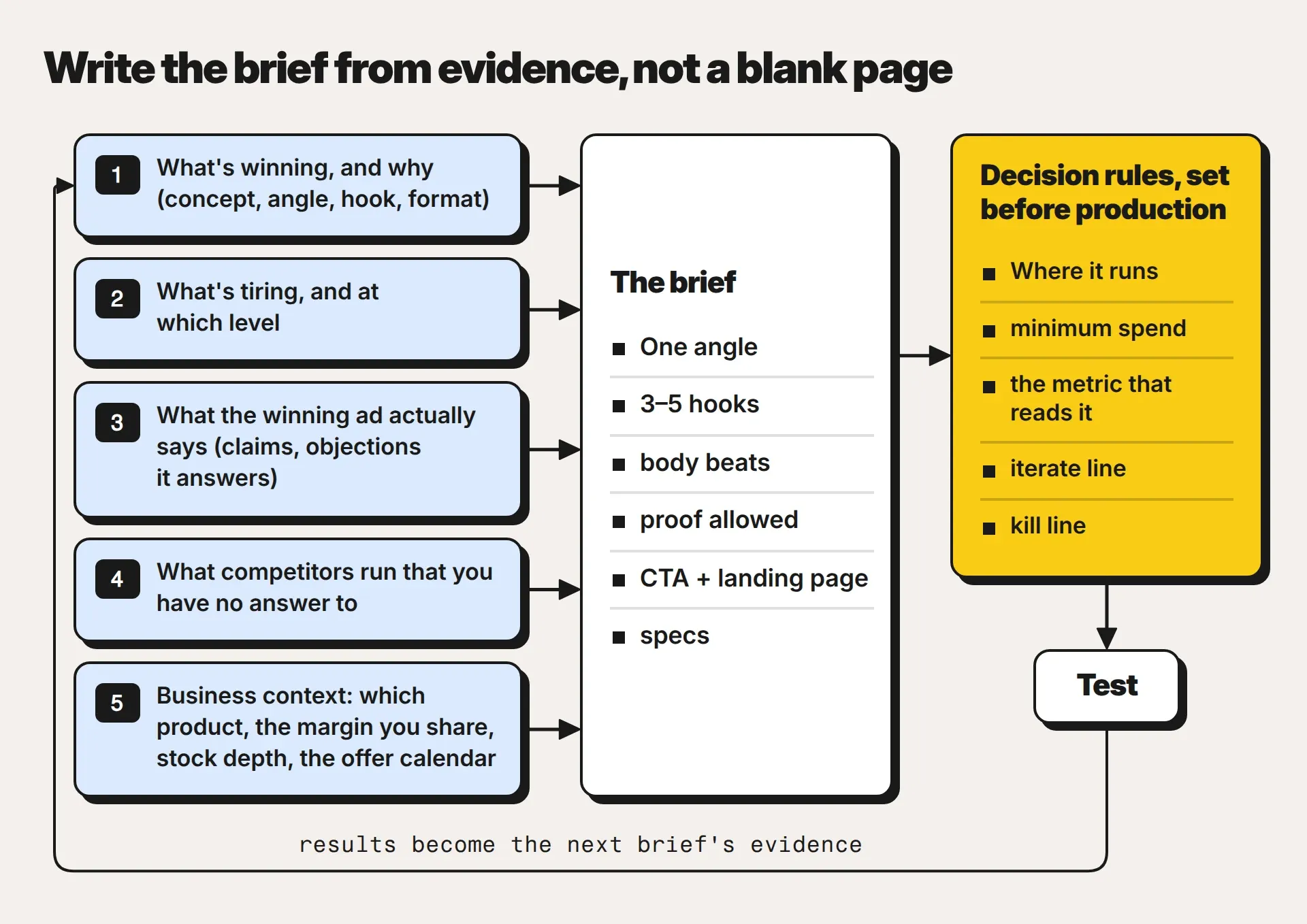
- → 1. What's winning, and why. Name the concept, angle, hook type and format behind your top two or three ads by spend, counting cuts of the same idea once. "Founder story, direct address, 60-second video" is a line an editor can use. "The founder video did well" isn't. Grouping cuts by hand is spreadsheet gymnastics, and still worth it. If your team blurs concept, angle and hook, our Meta ads creative testing framework separates the four levels.
- → 2. What's tiring, and at which level. Our two-condition test: link CTR 30% or more below the ad's own 7-day peak with frequency at 2.5 or higher, or 7-day cost per purchase at least 1.5× its own 30-day baseline while it's still spending. A CTR dip alone isn't fatigue. Then find the level, because it picks the brief: fatigue at four levels separates a tired execution from a tired concept.
- → 3. What the winning ad actually says. Watch it frame by frame and write three lists: the claims it makes, the objections it answers, and the proof it uses. Your winner is winning on something specific. If the brief can't name it, the next version will quietly drop it.
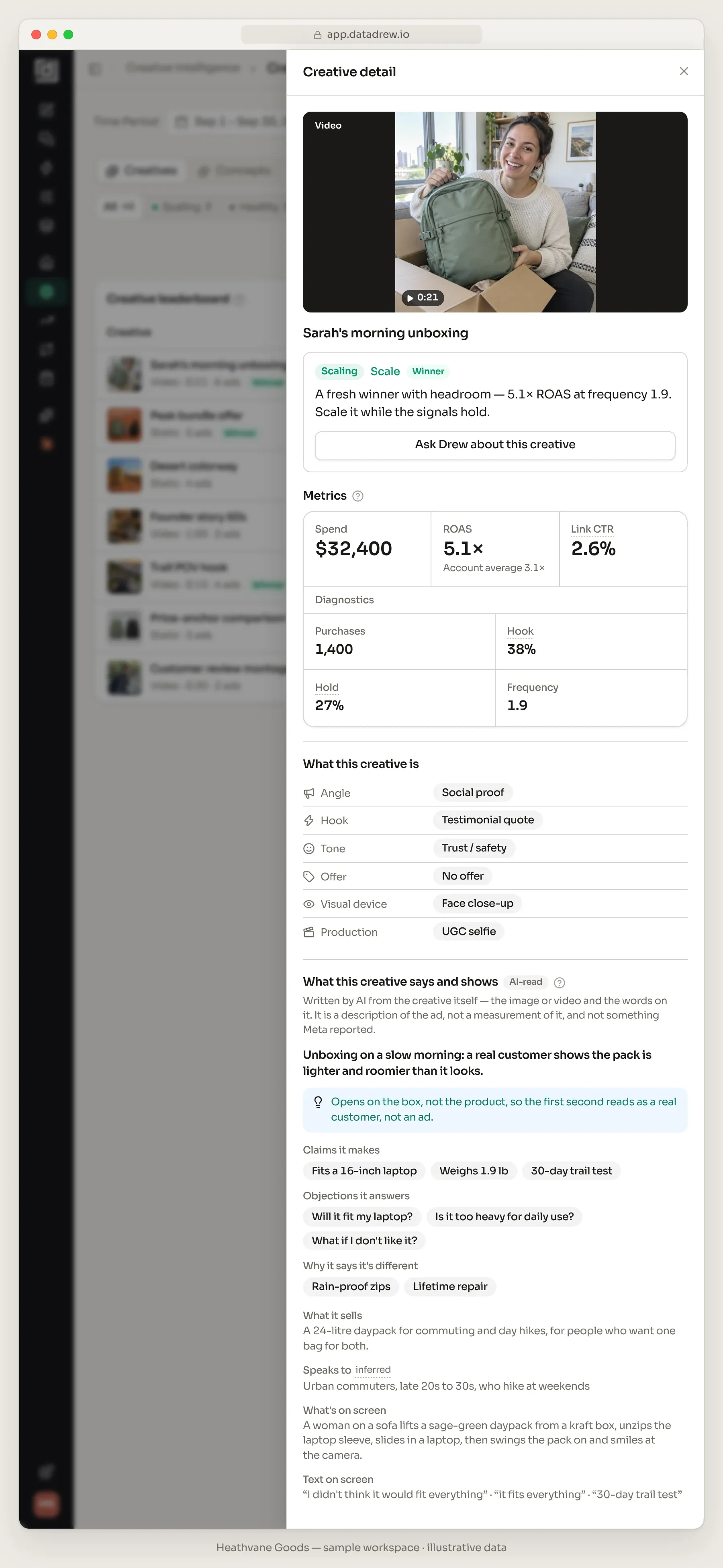
Take a sample account (illustrative numbers) used throughout this guide: Heathvane Goods, a Shopify brand selling daypacks and slings, about $18M a year, $186,400 on Meta in the last 30 days. Its top winner, "Sarah's morning unboxing", is a 21-second UGC video at 5.1× ROAS (Meta-reported) on $32,400.
Read off the ad, it makes three claims (fits a 16-inch laptop, weighs 1.9 lb, 30-day trail test), answers three objections (will it fit my laptop, is it too heavy for daily use, what if I don't like it) and gives two reasons it's different: rain-proof zips and lifetime repair.
- → 4. What competitors run that you have no answer to. Don't copy them; look for the argument you've never made. If three brands in your category lead with durability and you've never tested it, that's a new-concept brief. Meta's Ad Library shows what they run and since when, never spend or results, so a long run only tells you an ad survived. Our method for reading competitors' Facebook ads turns the scroll into a list of gaps.
- → 5. The business context. Name the product and check it can take the traffic: don't brief a hero ad for a SKU with three weeks of stock (see what ad spend on out-of-stock products costs). The price point and the margin you share decide how hard an offer can push; the offer calendar decides full price or sale. Then list the claims you can prove, because the edit will reach for the ones you can't.
Two briefs, not one: the iteration brief and the new-concept brief
Input 2 decides which brief you write, and it's the call that gets fudged. A founder video slides, someone says "we need new creative", and the team shoots a brand-new idea when the old one only needed a new opening. Ask the plain question first: is it the ad, or the concept?
| Iteration brief | New-concept brief | |
|---|---|---|
| Trigger | A winner graded Fatiguing: tired execution, concept still sells (a sibling cut holds, ROAS stays above your dead line) | A concept declining across all its versions, or a gap nobody in your category fills |
| What stays | Concept, angle, proof, product | Product and, often, the offer |
| What changes | First 3 seconds, first line, opening frame, creator or pacing, one at a time | The reason to buy |
| How many variants | 2–3, one variable each | 2–4 genuinely different executions |
| Test level | Hook and iteration | Concept |
| Evidence line | Hook rate against your median after about 5,000 impressions, then CPA at 15 purchases | 15 purchases and 5 delivery days at or under target CPA |
| Typical turnaround | Days | Weeks |
Never write a new-concept brief to fix a tired execution. Never write an iteration brief for a dead concept.
The first throws away an argument that still sells, and you pay to discover it twice. The second polishes an argument the market has stopped buying. New hook, same no.
The quickest tell is the siblings. If another cut of the same concept still holds while this one slides, the execution is tired. If every version slides together, it's the concept, and no new first frame will rescue it.
The ad creative brief template (copy it)
Sixteen fields, in the order you think them through. The table explains each one; the plain-text version under it is boring on purpose, so it pastes straight into Notion or Google Docs.
What goes in each field
| Field | What to write |
|---|---|
| 1. Brief type | Iteration or new concept. For an iteration, add two lines: what stays and what changes. |
| 2. The decision it feeds | The call this ad exists to make, in one sentence: replace a tiring winner, test an argument you've never run, launch a product. |
| 3. Product and business context | The SKU, weeks of stock, price, the margin you share, and whether it runs at full price or in a sale window. |
| 4. Evidence: what won and why | The parent ad or concept with its angle, hook type and format; its numbers (spend, ROAS, link CTR, hook rate, frequency, all Meta-reported); and what's tiring, at which level. |
| 5. What the reference ad says | The claims it makes, the objections it answers and the proof it uses, read off the ad itself. |
| 6. Who it's for (audience truth) | One person in one moment, e.g. "commuters who hike at weekends and want one bag for both". Describe a person; targeting settings belong in the ad set. |
| 7. The one argument (angle) | The single reason to buy. If the sentence needs an "and", you have two ads. |
| 8. Hooks to test (3–5) | Each one word for word, with its opening frame described: the first 3 seconds of a video, or the first line of primary text. |
| 9. Body beats | The argument in order, with rough timings. Beats leave the creator room to sound like a person. |
| 10. Proof and claims allowed | What you can back up (reviews, test results, guarantees) and what's off limits. |
| 11. CTA and landing page | The button, the words and the URL. The CTA names the landing page's next step. |
| 12. Format and specs | Length, aspect ratio (9:16 for Stories and Reels), captions on, readable with sound off, key elements clear of the edges. |
| 13. Deliverables and variants | How many cuts, what each variant changes (one variable each), raw footage, file names. |
| 14. Mandatories and don'ts | Must-show shots, banned words and claims, plus usage rights and whitelisting terms, agreed before the shoot. |
| 15. Test plan and decision rules | Where it runs, spend to a verdict, the metric that reads it, the iterate line and the kill line. After the test: which level lost, and why. |
| 16. Owner and dates | One owner, plus shoot, edit, launch and read dates. |
Copy the template as plain text
AD CREATIVE BRIEF
Name: [ ]   Version: [ ]   Date: [ ]

1. BRIEF TYPE
[ ] Iteration   [ ] New concept
Iteration only. Stays: [ ]   Changes: [ ]

2. THE DECISION IT FEEDS
[ one sentence: the call this ad exists to make ]

3. PRODUCT AND BUSINESS CONTEXT
Product / SKU: [ ]   Weeks of stock: [ ]
Price: [ ]   Margin you share: [ ]
Full price or sale: [ ]   Offer window: [ dates ]

4. EVIDENCE: WHAT WON AND WHY
Parent ad or concept: [ ]
Angle / hook type / format: [ ]
Numbers (Meta-reported): spend [ ] · ROAS [ ] · link CTR [ ] · hook rate [ ] · frequency [ ]
What's tiring, and at which level: [ execution / concept / nothing yet ]
Competitor gap, for a new concept: [ ]

5. WHAT THE REFERENCE AD SAYS
Claims it makes: [ ]
Objections it answers: [ ]
Proof it uses: [ ]

6. WHO IT'S FOR
[ one person, one moment ]

7. THE ONE ARGUMENT (ANGLE)
[ one sentence, no "and" ]

8. HOOKS TO TEST (3–5)
H1   Opening frame: [ ]   First line: [ ]
H2   Opening frame: [ ]   First line: [ ]
H3   Opening frame: [ ]   First line: [ ]
H4   (optional) [ ]
H5   (optional) [ ]

9. BODY BEATS
Video: [ beat ] → [ beat ] → [ beat ] → [ CTA ]   Length: [ ]
Primary text: hook → pivot → positioning → benefits → proof → offer → CTA

10. PROOF AND CLAIMS ALLOWED
Allowed: [ ]
Off limits: [ ]

11. CTA AND LANDING PAGE
Button: [ ]   CTA line: [ ]   URL: [ ]

12. FORMAT AND SPECS
Length: [ ]   Ratio: [ 9:16 / 4:5 / 1:1 ]   Captions: [ on ]   Works muted: [ yes ]

13. DELIVERABLES AND VARIANTS
Variant A: [ ]
Variant B: [ A plus one change: ]
Raw footage: [ yes / no ]   File names: [ ]

14. MANDATORIES AND DON'TS
Must show: [ ]   Never say: [ ]
Usage rights: [ channels, duration ]   Whitelisting: [ yes / no, how long ]

15. TEST PLAN AND DECISION RULES
Where it runs: [ ]
Spend to a verdict: [ 15–20 × target CPA = $ ]
Metric that reads it: [ ]
Iterate line: [ ]
Kill line: [ ]
Result (after the test): [ ]
Level that lost, and why: [ ]

16. OWNER AND DATES
Owner: [ ]   Shoot: [ ]   Edit: [ ]   Launch: [ ]   Read: [ ]
A filled-in iteration brief for a fatiguing winner
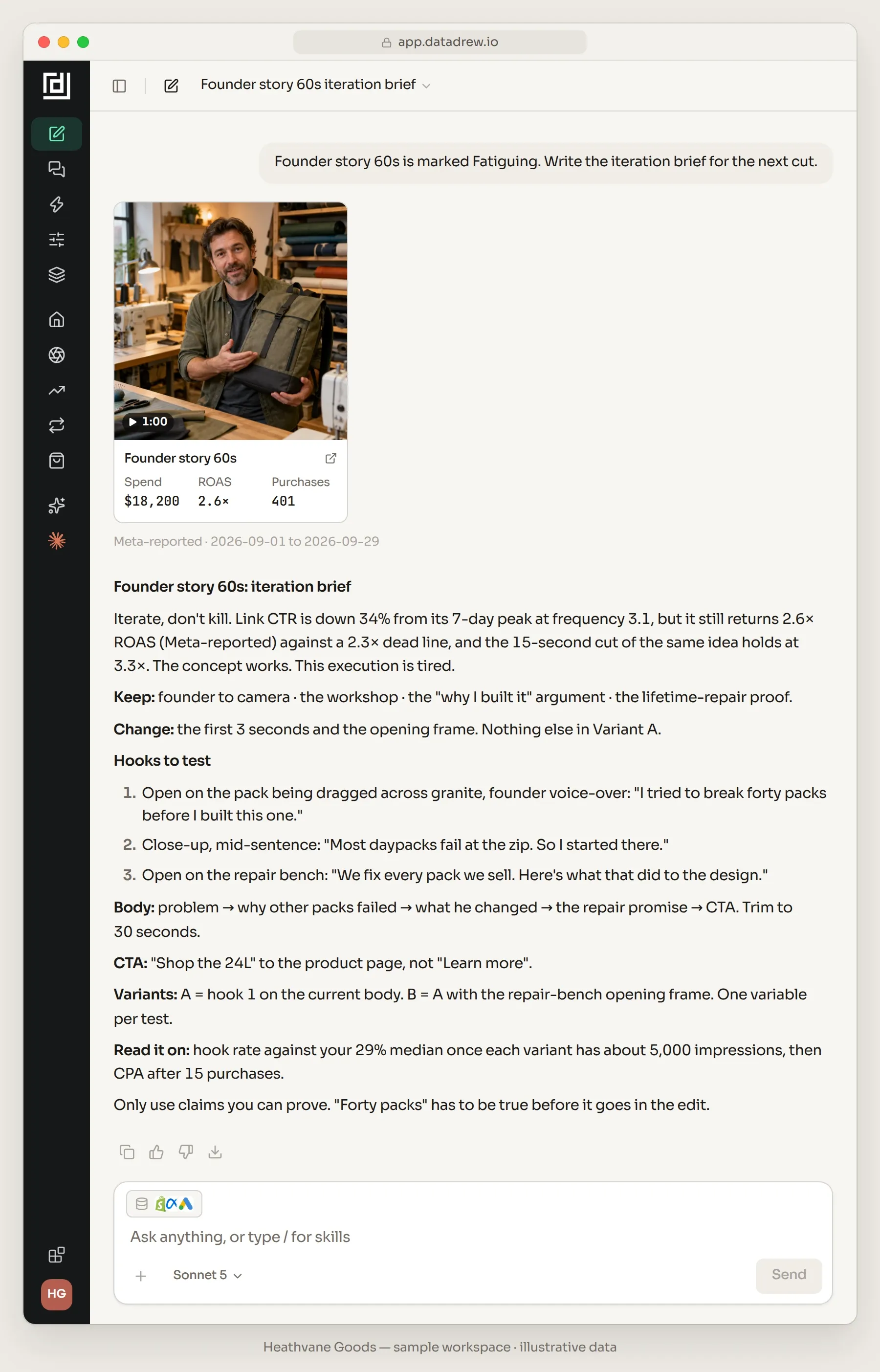
Heathvane's founder video, "Founder story 60s", has spent $18,200 at 2.6× ROAS (Meta-reported) on 401 purchases. Its latest 7-day link CTR is 1.10%, down 34% from its 7-day peak of 1.67%, at a frequency of 3.1. That's fatigue on the two-condition test.
But at 2.6× it still clears the account's 2.3× dead line, the ROAS under which a fatiguing ad counts as dead (the greater of 1.0× and 0.75× the 3.1× account average). The 15-second cut of the same concept holds at 3.3×. And the 60-second version hooks at 27%, under the account's 29% video median, so the opening was never its strong suit. Tired execution, working concept. Iteration brief.
| Field | Founder story 60s: iteration brief |
|---|---|
| 1. Brief type | Iteration. Stays: founder to camera, the workshop, the "why I built it" argument, the lifetime-repair proof. Changes: the first 3 seconds and the opening frame, nothing else. |
| 2. The decision it feeds | Replace Founder story 60s as the lead execution before it goes Dead. |
| 3. Product and business context | 24L daypack. In stock. Full price. |
| 4. Evidence: what won and why | $18,200 at 2.6× ROAS (Meta-reported), 401 purchases. Link CTR 1.67% → 1.10% (−34% vs its 7-day peak) at frequency 3.1. Dead line 2.3×. The 15-second cut holds at 3.3×. Hook rate 27% against a 29% account median. |
| 5. What the reference ad says | The founder, to camera in his workshop, on why he built the pack. Proof: lifetime repair. |
| 6. Who it's for | Unchanged. An iteration doesn't move the audience. |
| 7. The one argument (angle) | Unchanged: why I built it. |
| 8. Hooks to test | 1. Pack dragged across granite, founder voice-over: "I tried to break forty packs before I built this one." 2. Close-up, mid-sentence: "Most daypacks fail at the zip. So I started there." 3. Repair bench: "We fix every pack we sell. Here's what that did to the design." |
| 9. Body beats | Problem → why other packs failed → what he changed → the repair promise → CTA. Trim to 30 seconds. |
| 10. Proof and claims allowed | Lifetime repair. "Forty packs" only if it's true. |
| 11. CTA and landing page | "Shop the 24L", to the 24L product page. |
| 12. Format and specs | 30 seconds, 9:16, captions on, readable with sound off. |
| 13. Deliverables and variants | A: hook 1 on the current body. B: A with the repair-bench opening frame. One variable per test. |
| 14. Mandatories and don'ts | Founder on camera in every variant. No discount language; it runs at full price. |
| 15. Test plan and decision rules | Main campaign, beside the parent. Hook read at 5,000 impressions per variant, then CPA at 15 purchases. Full rules in the next section. |
| 16. Owner and dates | Owner: head of growth. Edit: the in-house editor. One short founder shoot covers all three openings. |
A hook is a claim, so the "forty packs" line only goes in if the founder really did try to break forty packs. No edit fixes a claim you can't back up.
Set the decision rules before production, not after the results
Rules written after the results turn every loss into a story. The hook "needed more time". The audience "wasn't warm yet". So write them into the brief while nobody is attached to the ad. The six, with Heathvane's numbers (target CPA $48):
| Rule | Why it matters | Heathvane example |
|---|---|---|
| Where it runs | An iteration has to beat its parent under the same conditions, so it runs beside it. Meta's creative fatigue guidance says keeping the original ad active "may maximize results". A new concept needs its own test lane and budget, or the proven ad next to it takes the spend. | Main campaign, beside Founder story 60s, which keeps running until a variant beats it. |
| Spend to a verdict | Don't call a creative before 15 purchases and 5 delivery days. At target CPA that's 15× CPA; budget up to 20× so an ad running a third over target still reaches a verdict. | 15–20 × $48 = $720–$960 per variant. |
| Hook read | Hook rate (3-second views ÷ impressions) settles long before CPA, so it's the cheap first read. Judge it against your own account's median. | At least 5,000 impressions per variant, against the account's 29% video median. |
| Iterate line | A fatigue signal while ROAS holds above the dead line means the concept still sells. Brief the next cut. | Fatigue signal with ROAS above 2.3×. |
| Kill line | Two ways out: it never sells, or it's tired and under the dead line. The zero-purchase cutoff is the one kill you make before 15 purchases, and it's your team's rule, set in target CPA. Datadrew's grading uses a different line for creatives with no purchases: 3× the account's median cost per purchase. | Team rule: zero purchases after $144 (3× the $48 target CPA). Or fatigued with ROAS under 2.3×. |
| What happens to losers | A loss you can't place is a loss you'll repeat. Write down which level lost (hook, execution or concept) and why, in the brief itself. | Logged in field 15 before the brief is archived. |
Write the rules in dollars. A Heathvane variant that hasn't reached 15 purchases by $960 is already paying more than $64 a purchase, a third over target. That rule survives a Monday stand-up. "Give it a few more days" doesn't. The data floors behind a fair verdict are in how long to test Facebook ads before you decide.
Briefing UGC creators without getting robotic ads back
Rogue and robotic are both brief problems. The fix is tight structure where the argument lives and loose direction everywhere else.
- → Ask for three openings per video: each creator films the first 3 seconds three ways, from the brief's 3–5 hooks, and the rest once. The opening is the cheapest thing to vary and the first thing your hook read judges.
- → Script the beats and leave the lines to the creator: problem → discovery → experience → result → recommendation. The beats carry the argument; the creator's own words stop it sounding read off a card.
- → Spec it for a phone on mute, then add sound on top: 9:16 for Stories and Reels, captions on, a message that reads with the sound off. Meta's best practices for Instagram video ads ask for your brand and key message "within the first 3 seconds" and "motion or a compelling visual in the first frame", and credit sound-on feed video with "2.25x higher CTA CTR".
- → Send one winning ad as "what good looks like". One. Send five references and you'll get the average of all five.
- → Ask for raw footage plus selects. The raw files are where your editor finds the next iteration without booking another shoot.
- → Settle usage rights and whitelisting before the shoot. Billo is blunt about it: "Usage rights, allowlisting, and paid media activation can easily double or triple costs." In the brief they're a line item; on the invoice, a surprise.
How Drew fits. Everything above works with Ads Manager, a spreadsheet and an honest hour. For a draft, ask Drew, the AI analyst inside Datadrew: "Founder story 60s is marked Fatiguing. Write the iteration brief for the next cut." It keeps the concept, changes the hook and cites the numbers behind the call. For creatives Datadrew has read (the ones carrying real spend; the page states its coverage), it can also cite what the parent ad claims and which objections it answers. You get text: hook → body → CTA, a 5-beat UGC script and A/B variants that change one thing. Drew doesn't make images or video; your editor or creator does.
For new-concept briefs, Rivals lists what tracked competitors launched and stopped in the last 7 days, from Meta's public Ad Library: one competitor on the free plan, up to five on paid plans. Brands you've viewed in the past week refresh daily, the rest weekly. No spend or results: Meta publishes none for commercial ads.
Creative data refreshes daily. Verdicts, Concepts and the Weekly Diagnosis page are on paid plans; the free plan lists your creatives with their metrics. See how Datadrew grades creatives and drafts briefs.
Key Takeaway
An ad creative brief is the only document between what your account proved and what gets filmed, so write it from five inputs: what's winning and why, what's tiring and at which level, what the winning ad says, what competitors run that you don't, and the business context. Pick an iteration brief for a tired execution and a new-concept brief for a tired concept, and never mix the two. Set the decision rules before production and log which level lost, so the next brief starts from evidence too. The creative performance hub covers the rest of the creative cycle.
Frequently Asked Questions
How do I brief the next ad from my winning ads?
Start with why the winner wins: its concept, angle, hook type and format, plus the claims it makes and the objections it answers. Of hook, format and angle, angle matters most, because it's why people buy; the hook is only why they stop. Then check whether the winner is tiring, and at which level, to choose between an iteration brief and a new-concept brief.
What should an ad creative brief include?
Sixteen fields: brief type, the decision it feeds, product and business context, evidence of what won, what the reference ad says, who it's for, one argument, 3–5 hooks, body beats, proof and claims allowed, CTA and landing page, format and specs, deliverables and variants, mandatories (including usage rights and whitelisting), the test plan with its decision rules, and an owner with dates. Most templates leave out two of them, the evidence and the decision rules, and those are the two that keep a brief from being a guess.
What's the difference between an iteration brief and a new-concept brief?
An iteration brief keeps a proven concept, its angle and its proof, and changes one execution variable per variant, usually the first 3 seconds, the first line, the opening frame or the creator. A new-concept brief changes the reason to buy and tests 2–4 genuinely different executions. Use the first when the execution is tired and the concept still sells; use the second when every version of the concept is declining, or when your category has a gap nobody fills.
How many hooks should a UGC brief ask for?
List 3–5 hooks in the brief, each written word for word with its opening frame described, and ask every creator to film three of them. Shooting the first 3 seconds three ways and the rest once gives you three variants from one session instead of three shoots. Read them on hook rate against your own account median once each has about 5,000 impressions.
Who should write the creative brief, the media buyer or the creative team?
Both, with one owner. The person closest to the data writes the evidence, the business context and the decision rules; the creative lead writes the hooks, beats and specs, because they know what can actually be shot. Without a creative strategist, the owner is usually the head of growth or the founder.
Can AI write our ad creative briefs?
AI can draft them, and a draft built from your account's data beats one from a chatbot that can't see it. Drew, the AI analyst in Datadrew, writes briefs as text when you ask: hooks, body beats, a 5-beat UGC script and one-variable A/B variants, built from your creatives' Meta-reported numbers. It doesn't make the ad; a person still films it, edits it and checks every claim is true before it runs.
Written by Sumit Bansal, co-founder of Datadrew. Published 30 September 2026. Meta platform facts (Meta's Help Center) and the O Positiv listing checked on 30 September 2026. Worked examples use a sample account with illustrative numbers. Datadrew deals in realized numbers with Shopify orders as the source of truth; we don't adjudicate which channel or creative deserves credit for a sale.