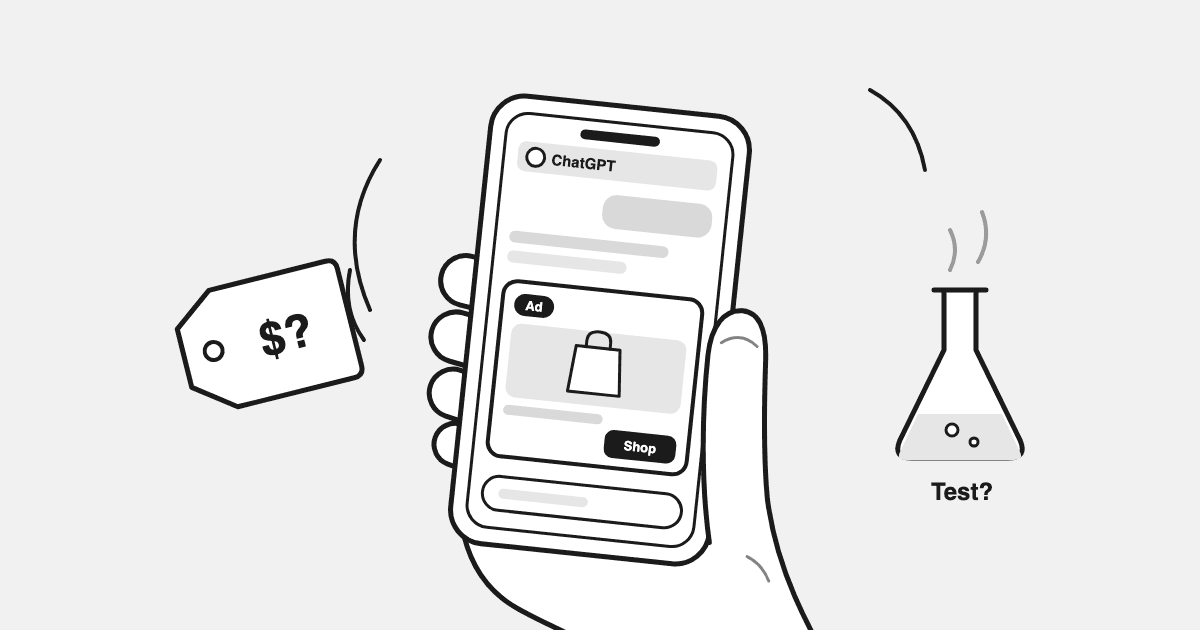
ChatGPT Ads is buyable by a Shopify brand today, self-serve in 52 countries, from $25 a day in the US, £15 in the UK, €15 in Europe and ₹725 in India, and a $500K–$30M Shopify brand should test it before Q4 only if a clean product feed and enough contribution margin before ads put it in the top-right box of the readiness 2×2 below. Everyone else has a cheaper job to do first.
This is a dated, sourced answer. Every platform fact below was checked against OpenAI's help centre and policies on 3 September 2026, and refreshed on 7 September against OpenAI's own advertiser product-update emails through 3 September; the platform is in beta and ships almost weekly — the six weeks to 3 September alone brought automated bidding, view-through conversion reporting, a carousel ad format and an Ads Manager you can drive from inside ChatGPT — so treat the numbers as current rather than permanent. It walks the five questions any operator asks about a new channel (budget, product, setup, measurement, next step) and ends with a calculator for the one that decides the rest: your unit economics.
One thing this is not. Datadrew does not report on or manage ChatGPT Ads. This is market education from a team that runs Meta and Google for Shopify brands and reconciles both against Shopify orders, which turns out to be exactly the habit this channel needs.
TL;DR
- Live and self-serve in 52 countries including the US, UK, EU and India. One labelled sponsored unit below a response, never inside it, shown only to adult Free and Go users.
- No keyword targeting, no lookalikes, no CPA or ROAS target, no video, and, in OpenAI's own words, no performance benchmarks yet. The targeting lever is free-form "context hints".
- The beta moves weekly. Between 24 July and 3 September 2026 OpenAI shipped automated bidding, one-day view-through conversion reporting, broader conversion matching, a multi-product carousel, geo exclusions, a Bulk API and a ChatGPT-native Ads Manager plugin.
- There is no Shopify sales channel for ChatGPT Ads. US stores are already discoverable in ChatGPT organically through Shopify Catalog; separate that traffic from paid before you judge anything.
- A change or cancellation can take up to one business day to take effect and you pay for ads served meanwhile. The "kill switch" is not instant.
- Test only from the "ready" box of the 2×2: a clean feed, a ring-fenced budget your margin survives at an assumed CPC and a 1–3% conversion rate, and Shopify orders as the number that counts.
Where ChatGPT Ads Stands Today (Last Verified 3 September 2026)
ChatGPT Ads is a beta, self-serve ad product that shows one labelled sponsored unit below a ChatGPT answer to logged-in adults on the Free and Go tiers. Here is the state of it on the verification date. We re-verify this box on the first Monday of each month.
| Question | Status | Source |
|---|---|---|
| Is it live? | Yes, in beta. Pilot Feb–Apr 2026, then self-serve through Ads Manager Beta. India went live on 27 August 2026 | OpenAI FAQ; TechCrunch, 27 Aug |
| Who can buy it self-serve? | Advertisers in 52 countries, including the US, UK, all of the EU, India, Japan, Korea, Brazil, Mexico and most of the Gulf. Sign up at ads.openai.com | Availability page |
| Where does the ad show? | One labelled sponsored unit below the end of a response, never inside the answer, to logged-in adults on the Free and Go tiers. Plus, Pro, Business, Enterprise and Education see none | TechCrunch; OpenAI ad policies |
| Minimum to start | A daily minimum by billing currency: $25, £15, €15, ₹725 (full table below). Release-configured; it has changed before | Create Campaigns |
| Bidding | CPM, CPC, or oCPC (conversion-optimised, still billed per valid click), plus a "Maximize results" automated strategy added 20 August 2026. Still no CPA or ROAS target. Objective cannot be changed after creation | Create Campaigns |
| Benchmarks | None. "ChatGPT Ads does not yet have performance benchmarks across advertisers, industries, or campaign types" | OpenAI FAQ, verbatim |
| How fast can you stop it? | A cancellation or change may take up to one business day to take effect, and fees continue for ads delivered meanwhile | Advertising Terms; The Register |
| Scale of the channel | OpenAI stated a $1B annualised run rate and "tens of thousands" of advertisers on 31 August 2026. Its own figure; nobody has verified it independently | OpenAI, 31 Aug |
Minimum daily budget by billing currency, from OpenAI's campaign guide on 3 September 2026:
| Country | Daily minimum | Country | Daily minimum |
|---|---|---|---|
| United States | 25 USD | Japan | 2,500 JPY |
| United Kingdom | 15 GBP | South Korea | 25,000 KRW |
| Europe (EUR) | 15 EUR | Brazil | 40 BRL |
| India | 725 INR | Mexico | 150 MXN |
| Australia | 25 AUD | Switzerland | 20 CHF |
| Canada | 25 CAD | Norway / Sweden / Denmark | 160 NOK / 175 SEK / 110 DKK |
| New Zealand | 25 NZD | Poland / Czechia | 65 PLN / 350 CZK |
What You Actually Get: Targeting, Bidding and Creative
ChatGPT Ads gives you country and platform targeting, uploaded audiences, free-form "context hints", three bid types and one chat-card creative format. If you buy Meta and Google, most of your instincts do not transfer.
Targeting. Country (plus state, DMA and ZIP inside the US, and specific locations you exclude), platform (iOS, Android or web, set per campaign), and uploaded custom audiences: inclusion lists still need roughly 25,000 matched users, exclusion lists can now sit below that floor, members can be added, removed or replaced without rebuilding the list, identifier types can be mixed in one request (Google Advertising ID among them), and lists can run past five million. None of it works in the EEA or Switzerland, and there are still no lookalikes. No demographics, interests or keywords in the classic sense.
Context hints. The channel's only keyword-like lever, and the thing to spend your setup time on. They are free-form phrases describing the need your product meets ("cushioned everyday running shoes for someone training for a first 5K" is the shape OpenAI's guidance uses), one theme per ad group. They are not exact-match controls and there is no report of which hint triggered an ad, so judge them by delivery and click-through rate. Write them from product titles, converting Google search terms and the words repeat customers use in reviews.
Bidding. CPM, CPC or oCPC, and since 20 August a Maximize results strategy that sets and adjusts the bid for you against your campaign goal. There is still no CPA or ROAS target, so your budget remains the only hard efficiency limit — automated bidding changes who picks the bid, not whether anything caps your cost per order. If you set bids yourself, OpenAI's suggested starting CPC has been $3–5, with a warning that bids much below $3 may not deliver (per Search Engine Land's reporting). Daily budgets pace as a seven-day average: one day can spend up to twice the figure, and campaigns with a total budget now pace across the flight too.
Creative. A chat card (short title, body up to 100 characters, one square image, advertiser name and favicon, landing page) or a product-feed template filled from your catalog — now carrying price and star ratings, with a multi-product carousel variant that shows several items in one unit. Still no video. Ad and landing page must match, and OpenAI's crawler (OAI-AdsBot) must be able to read your store or the ad is ineligible.
What Shipped Between 24 July and 3 September 2026
The fact box above is a snapshot of a platform that does not hold still. OpenAI emails advertisers a product-update roundup every couple of weeks, and the six weeks to 3 September changed enough that a piece written in July would now mislead you in four places. Here is the whole delta, taken from the roundups of 24 July, 5 August, 20 August and 3 September 2026.
| What shipped | When | Why a Shopify operator should care |
|---|---|---|
| Maximize results bidding | 20 Aug | The channel's first automated bidding: OpenAI sets and adjusts bids toward your campaign goal. It takes away the bid-cap guesswork that made early tests unreadable on a platform with no published benchmarks — and takes away a control. There is still no CPA or ROAS target underneath it |
| Conversion-optimised (oCPC) product-feed campaigns, in beta | 5 Aug | Catalog ads can optimise toward a conversion event, click-billed, with fixed or manual bidding and a positive conversion bid cap. You can clone an existing CPC campaign into an oCPC one, or create them in bulk |
| One-day view-through conversions in reporting | 20 Aug | Ads Manager now reports view-through conversions at campaign, ad group and ad level: a conversion within a day of an impression that no click claimed. It makes OpenAI-reported conversions larger without making Shopify orders larger. Read the click column and the view column separately, always |
| Automatic advanced matching turned on for existing web pixels | 17 Aug | AAM matches more conversions using hashed customer data from your site's forms. It became the default for new pixels in early August and was switched on for existing ones on 17 August unless the advertiser opted out first. If nobody on your side opted out, it is already on: check Tools → Conversions → Data Source, and check it against your privacy policy and consent banner |
| More Pixel and Conversions API matching fields | 3 Sep | The Pixel now accepts hashed phone, first name, last name, region and postal code; the Conversions API accepts list-valued versions of those plus city and country, and Android GAID for mobile. More match keys means more conversions the platform can claim |
| Multi-product carousel for feed campaigns | 5 Aug in test, reporting from 20 Aug | One unit showing several of your products. Carousel card impressions and clicks now appear in Ads Manager and at product level in the Insights API, on a rolling 30 days from 20 August. Card impressions are not billable impressions — keep them out of your CTR maths |
| Custom audiences became workable | 3 Sep | Add, remove or replace members without rebuilding a list, mix identifier types in one request, pass Google Advertising ID, go past five million members, and use lists under 25,000 matched users for exclusions. The 25,000 floor still applies to inclusion, and none of it works in the EEA or Switzerland |
| Geo exclusions, platform targeting and URL macros | 24 Jul – 20 Aug | Exclude specific locations; restrict delivery to iOS, Android or web; and use {campaign_id}, {ad_group_id}, {ad_id} and {ad_account_id} macros in landing-page parameters, filled at delivery time. That last one is what makes the UTM template further down fill itself in |
| Bulk API, and an Ads Manager plugin for ChatGPT | 24 Jul / 3 Sep | Create and update campaigns, ad groups and ads in bulk through the API. Or add the ChatGPT Ads Manager plugin and do the same in plain language from inside ChatGPT or Codex, with a preview and a confirmation step before anything is applied |
| Coming: impression-billed campaigns optimised on views | announced 3 Sep | OpenAI has said it will add a conversion model that optimises on clicks and views together, with impression-based billing. Notice what that does to a comparison: you would pay per impression while the platform reports conversions it credits to views nobody clicked |
Two of those matter more than the rest for anyone deciding whether to test. Automated bidding makes a small test readable, because you are no longer guessing a bid cap on a channel that publishes no benchmarks. And every measurement change on that list — advanced matching, more match fields, view-through reporting, view-through optimisation next — pushes OpenAI-reported conversions up without pushing Shopify orders up by a single unit. That gap is not dishonesty. It is a different question being answered. The rest of this piece is about not confusing the two.
What It Costs to Learn Anything
The real cost of ChatGPT Ads is not the $25 daily minimum. It is the price of an answer you can trust, and three platform facts set that price.
First, there are no benchmarks: OpenAI says so itself, which means every "ChatGPT ads CPC" figure you have read is one agency's sample. Second, a change or cancellation can take up to one business day to take effect and you are billed for what runs meanwhile, so a test you decide to stop on Friday afternoon may still be spending on Monday. Third, reporting lags: delivery data can trail by several hours and conversions by a day or two, so a Tuesday read of Monday is incomplete.
So the smallest honest test is a fixed budget over three to four weeks, read once a week on complete data, with the stop rule written before launch. A minimum-budget test buys single-digit clicks a day at the CPCs OpenAI suggests, which teaches you only that the platform exists.
The Shopify Reality: Feeds, Organic Discovery, and Where Orders Land
For a Shopify store, ChatGPT Ads means a Google-format feed you maintain yourself, an organic ChatGPT channel you may already have, and an order tally that Shopify counts but nobody reconciles. Three things the ads documentation does not lead with.
There is no Shopify sales channel for ChatGPT Ads. Product-feed ads take a Google-compatible feed file, uploaded as CSV, hosted at a URL, or pushed by SFTP, and items expire after 14 days unless refreshed. Your Google Shopping feed is the natural starting point (the Google Ads side of your setup already holds the shape), but keeping availability current is on you, and a sold-out product in a stale feed is the same leak it is everywhere else: ad spend on out-of-stock products.
US stores are already in ChatGPT for free. Since March 2026, US-selling Shopify stores with eligible products are discoverable in ChatGPT by default through Shopify Catalog, with checkout on your own store and orders arriving as normal online-store orders with ChatGPT referral attribution. Non-US stores have no syndication path today. That organic traffic is not ChatGPT Ads, and if you do not separate the two before a paid test, the test will "work" on orders you were getting anyway. (The organic side, and what "Shopify MCP" means in that context, is untangled in our Shopify MCP guide.)
Shopify's admin already counts AI-channel sales. The Agentic section shows sales, orders and sessions per AI channel, and Campaign Autopilot lists "ChatGPT Ads" as coming soon. The raw tally exists. The reconciliation of that tally against what you spent and what you kept does not.
Measurement: What Will Disagree, and the One Number You Can Bank
On a ChatGPT Ads test, Ads Manager, GA4 and Shopify will report three different numbers, and the only one you can bank is Shopify orders. "meta says 4.2x. ga4 says something else. shopify shows the bank truth." That line came from a Shopify founder, quoted as said, about the channels you already run. It applies with more force here, because this channel adds a fourth voice.
What will disagree:
- Ads Manager clicks vs GA4 sessions. A click tagged utm_medium=cpc from chatgpt.com lands in GA4's Paid Other channel; organic citations arrive as referral or the newer AI Assistant channel. Agencies report large gaps between clicks billed and sessions seen.
- Attribution windows, and now a separate view column. ChatGPT Ads reports on a 30-day click window with a fixed one-day view, and since 20 August it reports those one-day view-through conversions as their own line at campaign, ad group and ad level. Meta's default is seven-day click. Put those two ROAS figures on one card without saying which window each used and the comparison is meaningless.
- Matching that got broader three times in August. Automatic advanced matching became the default for new web pixels in early August and was switched on for existing ones on 17 August unless the advertiser opted out; on 3 September OpenAI added phone, name, region and postal-code fields to the Pixel and list-valued equivalents to the Conversions API. Each change raises the number of conversions the platform can claim, and none of them raises the number of orders in Shopify. If your OpenAI-reported conversions stepped up in mid-August with no change to your spend, that is the likeliest reason.
- Modelled conversions. Platform-reported conversions may include modelling; they are the platform's own count under its own rules.
The habit that keeps you honest is to label every number by who reported it: OpenAI-reported (its windows, matching and modelling), Shopify-observed (orders and revenue that exist, no causal claim), and the blended ratio (Shopify revenue over all ad spend for a scope you declare; efficiency, not attribution). The one you can bank is the middle one.
Set the UTM template once, at campaign level, so every ad inherits it:
utm_source=chatgpt.com&utm_medium=cpc&utm_campaign={campaign_id}&utm_content={ad_id}&utm_term={ad_group_id}
Those braces are OpenAI's own macros, supported since 24 July and populated at delivery time, so you set the template once and never edit it per campaign. Keeping chatgpt.com as the source for both organic and paid, with the medium as the split, is what lets you compare the two later. The mechanics of blending a third channel into MER are in how to calculate blended ROAS across Meta, Google and Shopify, and the case for treating Shopify as the source of truth in which ROAS number you can trust.
And if the conversions never arrive at all, check the plumbing before you judge the channel. Ads Manager has a diagnostics panel under Tools → Conversions that names the events it dropped, the field at fault, the error type and a suggested fix. A pixel that is silently rejecting events looks exactly like a channel that does not convert.
Is Your Store Ready to Test ChatGPT Ads? The Readiness 2×2
A Shopify store is ready to test ChatGPT Ads when two things are true at once: the product feed is clean and current, and the contribution margin before ads (CM2, the margin left after landed COGS, fulfilment and payment fees) can survive an assumed CPC at a 1–3% conversion rate. Plot those two on a grid and the decision draws itself.
A new surface competes for the same marginal dollar as everything else you run. The question is never "is ChatGPT interesting" but "is this the best use of the next dollar", which is a marginal ROAS question with a channel attached. The four boxes:
- Ready to test (clean feed, healthy CM2). Ring-fence a fixed budget for three to four weeks, under roughly a tenth of what you already spend on Meta and Google, sized to buy enough clicks to read. One hero product. Stop rule written before launch.
- Fix the feed first (messy feed, healthy CM2). Square images, live availability, a landing page OAI-AdsBot can crawl, a refresh cadence inside the 14-day expiry. A week of work, not a month.
- Fix margin first (clean feed, thin CM2). A $3 CPC at a 2% conversion rate is a $150 cost per order. If your margin per order is $40, no setup rescues it. Raise CM2 or pick a different SKU; the per-SKU arithmetic is in contribution margin before scaling ads.
- Not yet (messy feed, thin CM2). The novelty is not a reason. Spend the month on Meta and Google, and on stock cover.
Four checks apply in every box. Measurement hygiene: the pixel firing and validated in the diagnostics panel, the advanced-matching setting reviewed against your consent banner, and a UTM template set at campaign level before the first impression — platform-reported conversions with no Shopify cross-check are not a result. Category: lifestyle, household, apparel and non-regulated goods are fine; financial, health or legal are case-by-case and US only, and wellness copy with health claims is prohibited under ad policy v1.5. Entity and billing: a registered entity and a card in a self-serve country, verified before the test window opens. Inventory: cover for the whole test at the higher run rate, not ten days of the hero left.
One organic pre-check. On a Free-tier account, run buyer prompts in your category. If you or a competitor already appears, conversational demand exists; if nobody does, the test will be reading noise.
And one calendar rule. Do not launch a new channel in the middle of a sale. The sale changes conversion rate, order value and stock at once, and you will not be able to tell the channel from the promotion.
Can Your Unit Economics Survive a ChatGPT Ads Test?
Every input in this calculator is yours, because there are no benchmarks to borrow. Use OpenAI's suggested CPC range as a starting assumption and your own store's conversion rate as a ceiling; paid traffic from a new surface usually converts below it.
Test-envelope calculator
Any currency. Enter what you know; assumptions are yours to change.
Assumptions are yours; OpenAI publishes no benchmarks. Datadrew does not report on or manage ChatGPT Ads.
Know your break-even ROAS by SKU before you fund an unproven channel
- The free Datadrew audit reconciles your Meta and Google spend against Shopify orders and shows margin per product, so you can see which SKU has the CM2 headroom to carry a test.
- It does not touch ChatGPT Ads. It tells you whether you have a product that can afford one.
What Datadrew Can and Cannot Measure on a ChatGPT Ads Test
Datadrew does not report on or manage ChatGPT Ads, and it will not tell you which channel caused an order. What it shows, daily, is Shopify revenue, orders and profit alongside Meta and Google's own reporting and GA4 source/medium, which is exactly the frame a new-channel test needs.
Cannot. Drew has no ChatGPT Ads connector, so OpenAI-reported spend, clicks and conversions do not appear in it. Drew has not built attribution, so it never adjudicates which channel deserves credit.
Can. Three things that make a test readable. The daily Shopify baseline of orders, revenue and profit after COGS, shipping, fees, discounts and refunds, so the test weeks can be compared with the weeks before on the number that exists. GA4 source/medium next to that baseline, so chatgpt.com / cpc sessions (your UTM template above) and chatgpt.com referral sessions from the organic Catalog channel sit on one screen. And the blended ratio of Shopify revenue to all ad spend for a scope you declare, so a ring-fenced test shows up as a delta in blended results rather than a ROAS you take on faith.
That is channel visibility, not credit. The delta in blended profit over three to four weeks, with organic Catalog traffic separated, is the most honest read of a ChatGPT Ads test a Shopify brand can get today, and the same read Drew already gives you on Meta and Google.
India Specifically
India is OpenAI's second-largest market, with more than 100 million weekly users as of February 2026 by Sam Altman's own figure, and ads there run to logged-in adults on the Free and Go tiers (Go is ₹399 a month). Self-serve sign-up is open: OpenAI's availability page listed India when we checked on 3 September, after a launch announcement that had named 4 September. The first named Indian advertiser, per afaqs, is Honasa's Mamaearth, buying through Criteo.
What does not exist is a single India CPM, CPC, CTR or ROAS figure from any source. OpenAI's "no benchmarks" applies with extra force, and the pre-launch vendor estimates floating around were extrapolated from a US price that has since changed.
That puts the unit-economics question in sharper focus than anywhere else, because Indian D2C margins are already thin against Meta. One Indian operator, in a published piece we verified, put it this way: "Our Meta CAC is now ₹450. Product price is ₹599. We're literally paying customers to buy from us." At a ₹725 daily minimum and CPCs that nobody has published, the honest test is a fixed envelope of a few thousand rupees a day for three to four weeks on a hero product with real margin, or no test at all. The novelty is not a reason. The margin is.
Setup and Access Facts for Agencies and Operators
- One API key per ad account, created by an account Admin, with full write access: no read-only scope, no manager-account structure like Google's MCC. A Bulk API for creating and updating campaigns, ad groups and ads asynchronously landed on 24 July.
- You can now drive Ads Manager from inside ChatGPT. A first-party ChatGPT Ads Manager plugin, announced 3 September, turns a brief or a website into ready-to-launch drafts, spins up variants, updates campaigns, troubleshoots delivery and ranks recommendations, in plain language from ChatGPT or Codex. It previews the changes and asks before applying them. Treat it as you would any agent with write access to a spend account: excellent for drafting, not a reason to stop reading the diff before you confirm.
- Agencies do not open accounts for clients. The client creates the account under its own entity and card, then invites the agency as admin, member or viewer.
- Who reports on it today. Triple Whale shipped a ChatGPT Ads reporting connector on 28 July 2026 and added Sonar Optimize for the channel on 5 August; WorkMagic connected on 20 August; Hightouch can push conversions through the Conversions API; AppsFlyer and Adjust cover app installs. All sit on or alongside OpenAI's published partner list. If you already use one, it is the fastest way to get the platform's numbers next to your others.
- Who does not. Datadrew. Drew manages Meta and Google and reconciles their spend against your Shopify revenue into one blended number, daily, with platform figures labelled alongside. Whatever you test, the number you bank is Shopify orders, and that is the number Drew already keeps straight.
If a reconciled Shopify-first view of Meta and Google is the missing piece before you add a fourth voice to the argument, pricing is published and flat and the free plan doesn't need a card.
Key Takeaway
ChatGPT Ads is real, self-serve in 52 countries, and cheap to start: $25, £15, €15 or ₹725 a day. It is also a beta that changes weekly — automated bidding, view-through conversion reporting and a ChatGPT-native Ads Manager all arrived in the six weeks to 3 September — and it still has no keyword targeting, lookalikes, CPA or ROAS target, video or benchmarks, and a stop button that can take a business day. For a Shopify brand it is a margin decision, not a novelty decision: test only from the top-right box of the readiness 2×2, with a ring-fenced budget your contribution per order survives at an assumed CPC and a 1–3% conversion rate, separate organic Catalog traffic from paid, label every number by who reported it, and bank Shopify orders.
FAQ
How much do ChatGPT Ads cost for a Shopify brand?
The floor is a daily minimum set by your billing currency: 25 USD, 15 GBP, 15 EUR, 725 INR, 25 AUD, 25 CAD or 2,500 JPY, per OpenAI's campaign guide on 3 September 2026. Above the floor you pay per click, and OpenAI's suggested starting CPC has been $3–5. At $3 and a 2% conversion rate that is $150 per order, which is why the cost that matters is your contribution margin per order, not the minimum. There are no published CPM, CTR or ROAS benchmarks from OpenAI.
Should a Shopify brand test ChatGPT Ads before Q4 2026?
Only from the "ready" box of the 2×2: a clean, current product feed and a contribution margin before ads that survives an assumed $3–5 CPC at a 1–3% conversion rate. If both hold, ring-fence under a tenth of your Meta and Google spend for three to four weeks on one hero product, stop rule written first, no launch during a sale. If either fails, the cheaper job comes before the test.
Which countries can buy ChatGPT Ads self-serve?
Fifty-two as of 3 September 2026, including the United States, United Kingdom, the EU member states, India, Japan, South Korea, Brazil, Mexico, Australia, New Zealand and most Gulf states. Advertisers elsewhere can register at ads.openai.com to be notified when self-serve opens; larger advertisers can go through OpenAI's sales team or its partners.
Who sees the ads in ChatGPT?
Logged-in adults on the Free and Go tiers. Plus, Pro, Business, Enterprise and Education subscribers do not see ads. The unit appears as a single labelled sponsored placement below the end of a response, never inside the answer, and advertisers receive aggregate impressions and clicks, never conversations or chat history.
Can I run video ads or lookalike audiences on ChatGPT?
Neither, as of 7 September 2026. Creative is a chat card (short title, body up to 100 characters, one square image) or a product-feed template, which now carries price and star ratings and has a multi-product carousel variant. Custom audiences can be uploaded for inclusion (roughly 25,000 matched users needed) or exclusion (no minimum since 3 September), members can be added, removed or replaced without rebuilding the list, and identifier types including Google Advertising ID can be mixed — but there are still no lookalikes, and audiences are not available in the EEA or Switzerland.
Does ChatGPT Ads have automated bidding?
Yes, since 20 August 2026. The Maximize results bid strategy lets ChatGPT Ads set and adjust bids on your behalf toward your selected campaign goal. It is not a target-CPA or target-ROAS strategy — no such target exists on the platform — so your daily or total budget is still the only hard limit on what a test can cost you. Manual CPC, CPM and conversion-optimised CPC bidding all remain available.
What changed in ChatGPT Ads recently?
Between 24 July and 3 September 2026 OpenAI shipped automated bidding, conversion-optimised product-feed campaigns in beta, one-day view-through conversion reporting, automatic advanced matching on existing web pixels (17 August), extra Pixel and Conversions API matching fields, a multi-product carousel format, geo exclusions, platform targeting, dynamic URL macros, a Bulk API, total-budget pacing, much more flexible custom audiences, and a ChatGPT Ads Manager plugin. An impression-billed campaign type optimised on clicks and views together has been announced but not shipped.
Can I manage ChatGPT Ads from inside ChatGPT?
Yes. OpenAI announced a first-party ChatGPT Ads Manager plugin on 3 September 2026. Add it from Plugins, connect your ad account, and you can turn a website or brief into ready-to-launch ads, create variants, update campaigns, troubleshoot delivery and review performance in plain language from ChatGPT or Codex. It previews recommended changes and asks for confirmation before applying them, so it drafts rather than acts unsupervised.
How quickly does pausing a ChatGPT Ads campaign stop the spend?
Not instantly. OpenAI's Advertising Terms state that a cancellation or change may take up to one business day to take effect, and you remain responsible for ads delivered in that period. Reporting lags too: delivery data can trail by several hours and conversions by a day or two, and no learning phase is documented. Build both into your stop rule: if the test must end on a date, end it a business day early, and read results on complete weeks.
Can a Shopify brand in India advertise on ChatGPT?
Yes. India went live on 27 August 2026 for Free and Go users, self-serve sign-up is open, and the daily minimum is 725 INR. You need an India-registered entity and a corporate card in that country. No India-specific performance benchmarks exist from any source, so size the test from your own margin and an assumed CPC.
Written by Sumit Bansal, co-founder of Datadrew. Published 3 September 2026, last verified 3 September 2026, updated 7 September 2026. Platform facts were checked against OpenAI's help centre and policies and are linked inline, and the product-update timeline comes from OpenAI's advertiser roundups, dated in the table above; the platform is in beta and we re-verify the fact box on the first Monday of each month. Datadrew does not report on or manage ChatGPT Ads.